oxygen domain was triggered too early. This is usually an indicator for some code in the plugin or theme running too early. Translations should be loaded at the init action or later. Please see Debugging in WordPress for more information. (This message was added in version 6.7.0.) in /home/rdunsire/public_html/wp-includes/functions.php on line 6260wordpress-seo domain was triggered too early. This is usually an indicator for some code in the plugin or theme running too early. Translations should be loaded at the init action or later. Please see Debugging in WordPress for more information. (This message was added in version 6.7.0.) in /home/rdunsire/public_html/wp-includes/functions.php on line 6260Émilienne Moreau
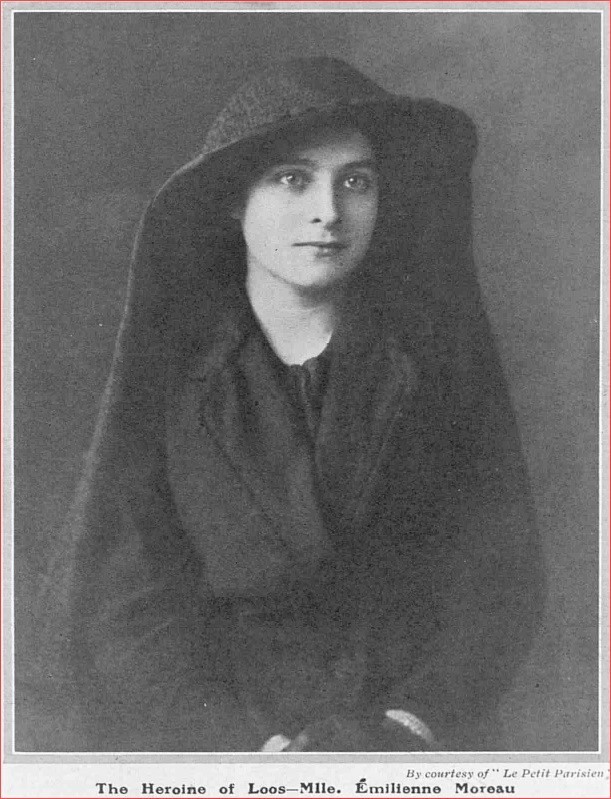
Émilienne Moreau moved to Loos in June 1914, after her
father had retired as a miner and become a manager of a small shop in the main
square of Loos. Soon the Germans occupied the village and Émilienne was indignant
about the actions of the invading forces. Though only 16 years old, she set up
an observation post in the attic and watched through binoculars, observing the
Germans digging shelters on the slag heaps and, on 8 October 1914, she saw a
machine-gun post being set up. Seeing French soldiers on the hill, she set out
to warn the French soldiers, running through a hail of gunfire to do so. Her
bravery was recognised by a sergeant and she was told she was ‘a very brave
girl’. When the town hall was in flames, she ran to put out the fire to save
the public archives, ignoring German warnings and threats.
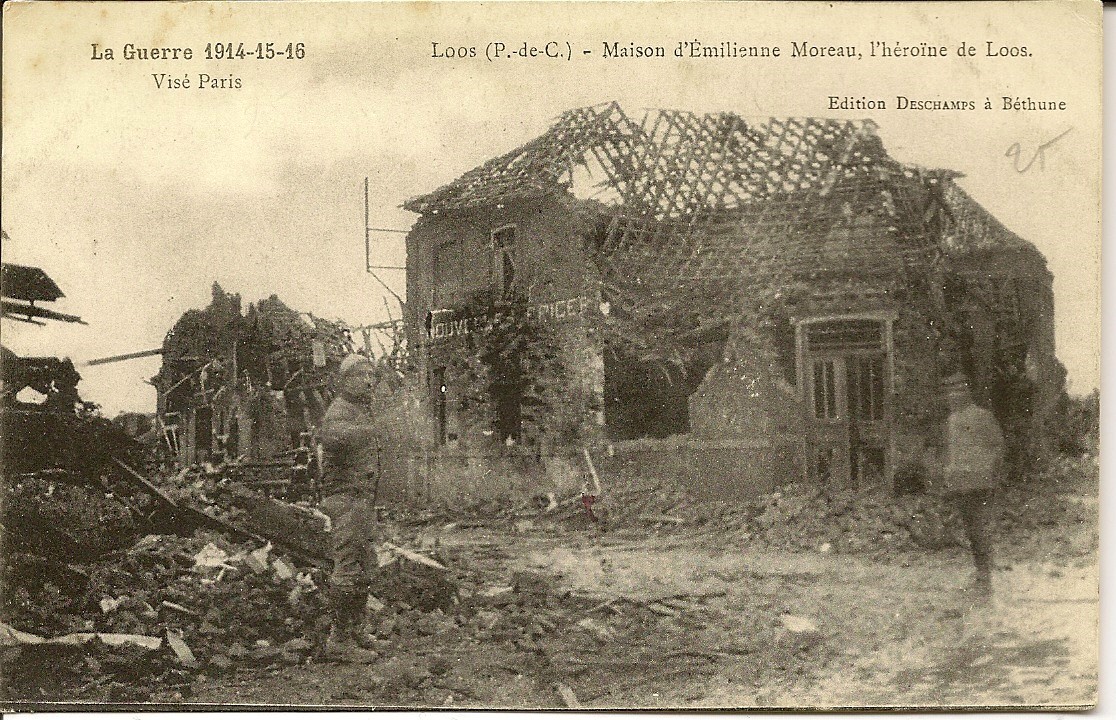
As this later postcard image illustrates that the home and
shop of Émilienne’s parents and family was destroyed during the sieges of
Loos-en-Gohelle but the family stayed on. During the Battle of Loos, Émilienne
decided to give first aid to any injured British soldiers passing through the
town. With her mother, she transformed the family home into a hospital and
provided assistance to a British doctor who set up a clinic there. As the
Battle of Loos rolled on, the streets were filled with many seriously wounded
soldiers. Émilienne left the safety of her home to go on to the streets, under
gunfire, to take drinks to those in need and separate the wounded from the
dead.
When she saw three Germans head towards an injured Scottish
soldier, she decided to attack them, accompanied by three other wounded
soldiers, telling them, ‘I’ll go first’. Despite their attempted stealth, they
were heard and subjected to more gunfire and bullets. She told the wounded
soldiers to stop and showed them the doors to a cellar and, then amazingly,
asked for two grenades.
The act which was to finally immortalise her actions
occurred when Émilienne was with another soldier on a stretcher and was
confronted by two German soldiers who pointed guns at them. Their shots missed
but the now 17-year-old Émilienne’s did not: ‘The young girl spotted a
revolver. Émilienne grabbed hold of it. Feverishly, she fired shot after shot
at random and the Germans, shot at almost point-blank range, fell one after the
other.’
Later, when on the way to Béthune as she took her sister for
treatment for a shell injury, Émilienne was stopped and taken to the side and
spoken to by a British senior officer, who wanted to thank her and tell her
that he had advised both the French and British Governments of her actions.
Soon after, on 27 November 1915, following a mention in
dispatches by General Ferdinand Foch, General de Sailly presented Émilienne
Moreau with the Croix de Guerre with Palm. On the recommendation of General
Douglas Haig, the British Ambassador in Paris also awarded her, in the name of
King George V, the Military Medal, the Royal Red Cross First Class and the
Medal of the Order of St John of Jerusalem.
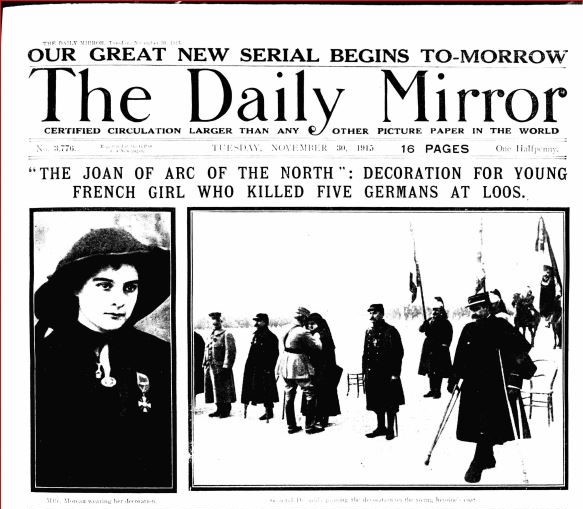
Attr: Daily Mirror - Tuesday 30 November 1915 Image © Mirrorpix/Reach Licensing.
Image created courtesy of THE BRITISH LIBRARY BOARD.
Émilienne was later to become the subject of a film, Joan of
Arc of Loos, that was released in the UK in 1917
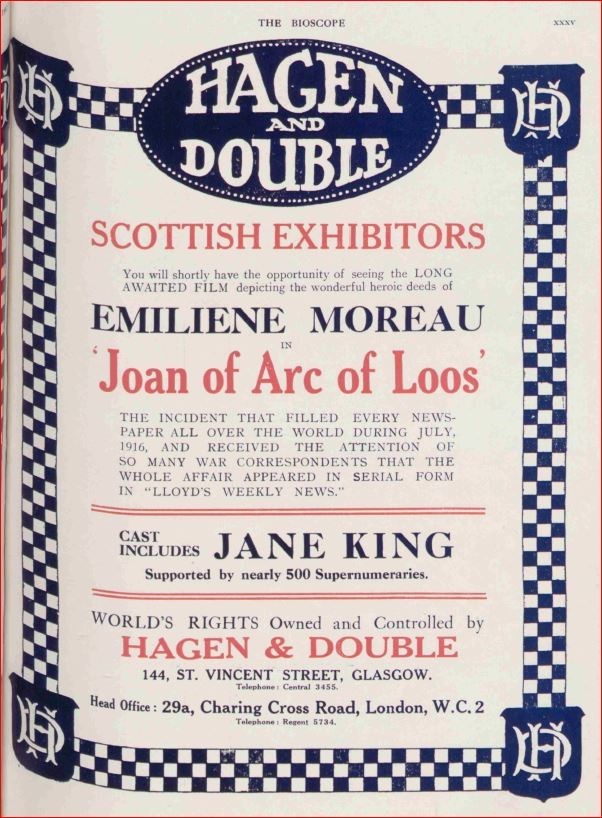
Attr: The Bioscope - Thursday 17 May 1917
Newspaper image © The British Library Board. All rights
reserved.
With thanks to The British Newspaper Archive
(www.britishnewspaperarchive.co.uk).
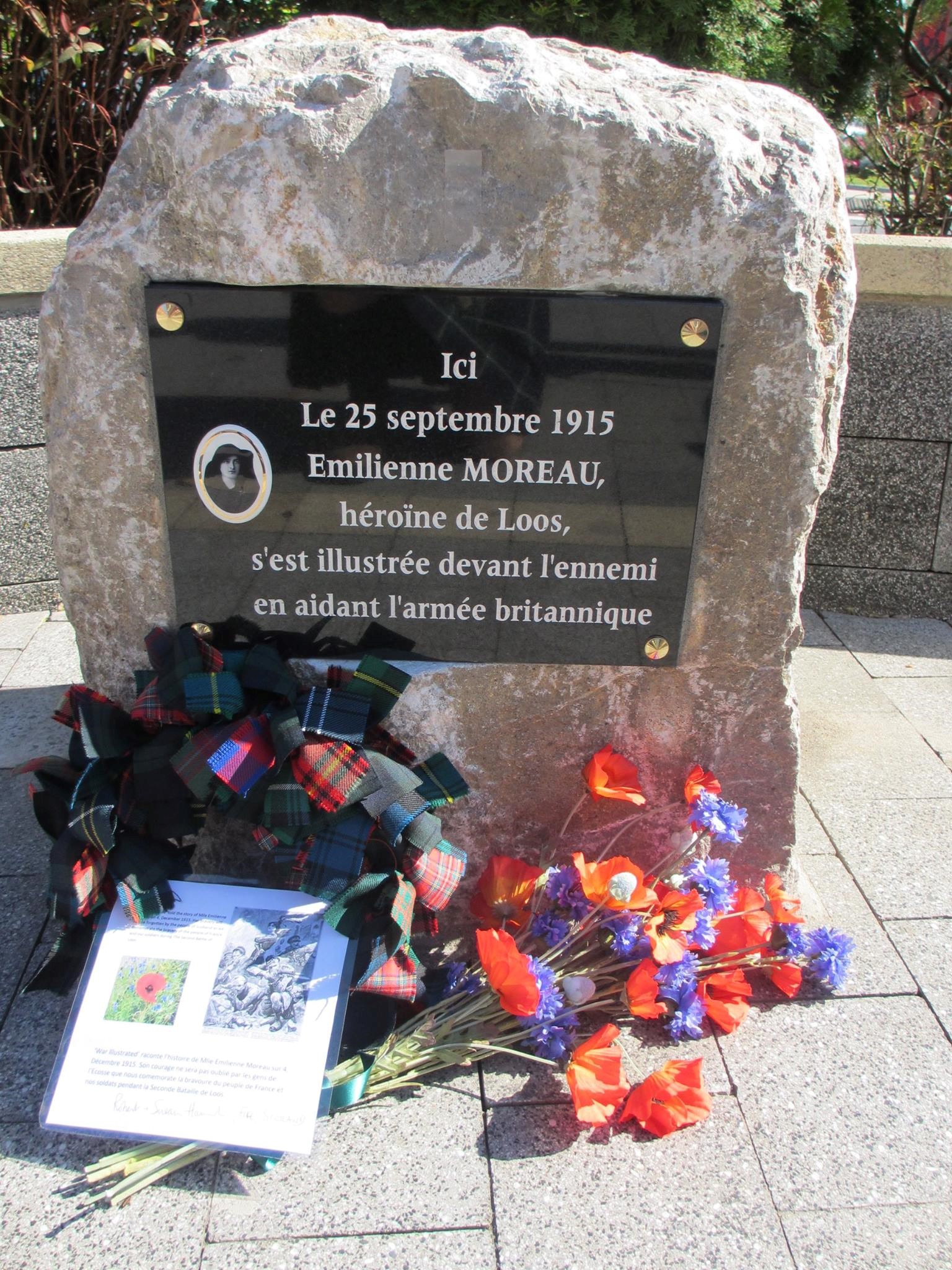
This photograph shows my own personal tribute to Émilienne
Moreau, which I laid at the memorial in the centre of Loos en Gohelle in
October 2015. The wreath of many tartans symbolised all the Scottish soldiers
that Émilienne looked out for and helped in 1915. The
blue cornflowers and red poppies symbolise remembrance of all the French and
British soldiers who served at Loos.
In late 2017, the Princess Royal, Princess Anne, named the
main auditorium of the new French Institute and French Consulate General in Edinburgh,
Salle Émilienne Moreau-Evrard. Émilienne had married Just Evrard in 1932. The Consulate
General is in the former Lothian Chambers on The Royal Mile, opposite St Giles
Cathedral, in the heart of Edinburgh. This tribute again underlined the strong association
between Scotland and Émilienne.