oxygen domain was triggered too early. This is usually an indicator for some code in the plugin or theme running too early. Translations should be loaded at the init action or later. Please see Debugging in WordPress for more information. (This message was added in version 6.7.0.) in /home/rdunsire/public_html/wp-includes/functions.php on line 6260wordpress-seo domain was triggered too early. This is usually an indicator for some code in the plugin or theme running too early. Translations should be loaded at the init action or later. Please see Debugging in WordPress for more information. (This message was added in version 6.7.0.) in /home/rdunsire/public_html/wp-includes/functions.php on line 6260The content of a very moving interview, made in 1986 by The
Imperial War Museum with William John Collins describes, amongst many other
such experiences, his recollection of the evening when Robert Dunsire was
brought in to his Ambulance Station, based near Vermelles, after being struck
by shrapnel from a German trench mortar.
William Collins served as a stretcher bearer with the Royal
Army Medical Corps attached to the 7th Brigade Royal Horse Artillery. He was on
duty when Robert Dunsire and James Sproul of the 13th Battalion of the Royal
Scots were brought into the 46th Ambulance Station from Hulluch Alley trenches
on 3 January 1916.
I looked at him and he was very badly wounded. I just turned
him a bit and looked at his chest. I said, ‘Well, come down to our aid post
because we’re the nearest point here’. It was not far off the bottom of the
communication trench and I took them to our hole in the ground at Vermelles and
we put him on the crate and I think it was Captain Graham who leaned over and
looked at him. He took his jacket off and stripped him down and he’d got
multiple wounds, he was literally like a pepper pot, and gave a little sigh and
died. And then Captain Graham said, ‘Well, there’s nothing we can do,’ and he
said to me, ‘You go through his pockets,’ and he told the chaps from this
regiment, it was the Royal Scots, ‘Anything he has we’ll send them through to
his next of kin. There’s sure to be a letter in his pockets. Tell your officer
that we’re going to send these little things home to his next of kin.’
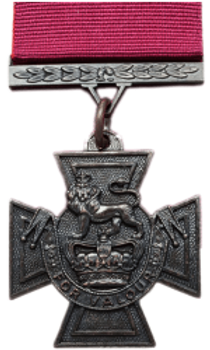
And I looked at his chest and I saw the ribbon there. I said ‘That’s the Victoria Cross, sir,’ and Captain Graham looked and said, ‘Yes, so it is. This is a VC.’ I took his documents out and he was Private Robert Dunsire VC, Royal Scots. There was a letter from home, so I got his address, and an envelope with a document telling him he’d just been promoted to lance corporal and in the envelope was his lance corporal stripes: he’d never had time to put them on his sleeve. It was the most tragic thing to me.
-------------------------------------------------------------------------------------
This fascinating and memorable interview brings an immediacy
to the tragic death of Robert Dunsire VC. It occurred some seven weeks after he
had returned to his battalion and frontline action, having been to Buckingham
Palace to receive his medal from King George V. Robert would still have fresh
memories of his journey home and all of the events that swamped his two weeks’
furlough.
William Collins was recalling an incident from 70 years ago.
It had clearly still made a significant impact on him after all this time. This
is a remarkable piece of historical commentary. We are indebted to The Imperial
War Museum for the creation of this oral treasure.