oxygen domain was triggered too early. This is usually an indicator for some code in the plugin or theme running too early. Translations should be loaded at the init action or later. Please see Debugging in WordPress for more information. (This message was added in version 6.7.0.) in /home/rdunsire/public_html/wp-includes/functions.php on line 6260wordpress-seo domain was triggered too early. This is usually an indicator for some code in the plugin or theme running too early. Translations should be loaded at the init action or later. Please see Debugging in WordPress for more information. (This message was added in version 6.7.0.) in /home/rdunsire/public_html/wp-includes/functions.php on line 6260There was no faster way home in 1915, so Robert travelled by
train, boat and 2 further train journeys before he reached Kirkcaldy Station at
19.10, on Monday, 22 November. He could not have imagined the whirlwind of the
days to follow; his priority was to get back to his bride of 16 months, Kate.
Robert’s original furlough was planned as 10 days. This was
later extended by The War Office on the intervention of Mr Leslie, Town Clerk
of Buckhaven, Methil and Innerleven Council. Throughout the period of his
extended furlough Robert Dunsire demonstrated his many personal skills, an
awareness of the need for more volunteers to support his fellow soldiers on the
front, and an ability to be comfortable and astute when speaking at public
events, while coping with the maelstrom generated by those who wanted to
celebrate and publicly recognise his Victoria Cross.
Robert had demonstrated that same calm assurance during the Act
of Valour that led to his award. Many refer to a soldier winning a medal, but
it is not a competition for the best or fastest performance; it is an Award for
outstanding and measured behaviour and bravery in the face of a deadly enemy.
All newspaper reports highlight his understated and modest
personality that probably stemmed from his upbringing and own religious beliefs
– it was said that he always carried his bible in his pocket. He genuinely
cared and thought of others.
He was about to call on all of his personal resources and
skills once he was back home in Fife on Monday, 22 November 1915. He did this
with distinction and aplomb while appearing to be unfazed by the fuss. When he went
on to receive his Victoria Cross medal from King George V, Robert said that
anyone would have done the same and that it was nothing much – a very typical
Robert self-deprecating response!
As Robert Dunsire VC made his way home from the Wemyss Tram
that dropped off at Denbeath at 20.40 he was greeted by crowds who wanted to
shake his hand. He had already faced a wonderful welcome when he stepped off
the train at Kirkcaldy some 90 minutes earlier.
Kate had received a telegram from Robert earlier in the day
to say that he was in London and would be home around midnight that Monday
evening, or the next day. Since the announcement, Kate had had a trail of the
provost, magistrates and prominent locals calling to pass on their
congratulations. One can only imagine her delight when he stepped off the tram.
A trench-stained Robert Dunsire only wanted the comforts of his own home –
ceremonies could wait.
Meanwhile, at his parents’ home in Pathhead, Kirkcaldy, the Sunday
Post captured Robert’s parents’ reaction about the news in its own inimitable
style.
Robert was referred to as ‘Bob’ throughout their interview,
and their muted response only echoed the positive and important news that their
son was safe and well. It also notes their pride and joy at his award of the
Victoria Cross.
However, it was left to The Daily Record to feature a
photograph of Bob’s parents. That newspaper was to play a prominent part in
carrying photographs of the events of the following days.
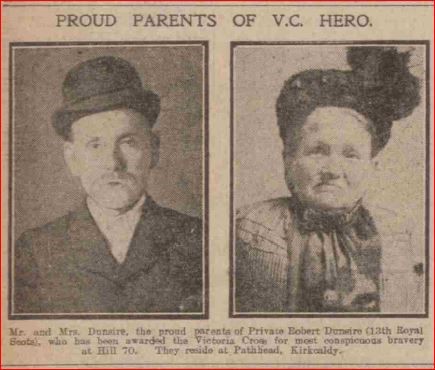
Attr: Image © Mirrorpix/Reach Licensing.
Daily Record - Monday 22 November 1915
Image created courtesy of THE BRITISH LIBRARY BOARD.
Robert had one night's rest after his journey and initial welcoe home before he was thrown into a whirlwind round of public engagements.
On 22 November 1915, Buckhaven, Methil and Innerleven Town
Council had passed a resolution to organise a welcome home reception for
Robert, which was held at the White Swan Hotel with Provost Rose presiding. In
reply to the toast to their first (and only) local VC, Robert thanked Provost
Rose politely, but quickly repeated a personal message: there were not enough
men at the front; they should be relieved more frequently; and the young men of
the country should take up arms and help. The welcome music was provided by
Buckhaven Town Band
After the initial reception, they followed a piper to the
Gaiety Theatre – also the local recruiting office – where Robert was given a
rousing reception by the gathered company of locals. After the initial welcome
and a stand-up chorus of ‘For he’s a jolly good Fellow’, Robert again thanked
them for their reception, but quickly remarked that he was better at fighting
than speechifying, and reiterated his message on the work of soldiers at the
front and the need for more men. Robert commented that life out there was very
hard: 4 hours’ duty to 12 hours out of the trench, working all the time; very
little sleep; and only snacks for meals. He did balance his comments by being
positive, saying, ‘Still, we are doing well and are cheery’.
The Scottish Revues Syndicate Company that was performing
the Theatre Revue, ‘It’s a Nice Night’, presented Robert with gifts of a
handsome case of pipes and tobacco pouch and a gold locket for Kate, his wife.
The presentation was made by Mr Lindsay of Lindsay and Harte. It was then
reported that, before Robert could reach his chair an actress. Dora Lindsay, a
member of the company, bounded on the stage and embraced him.
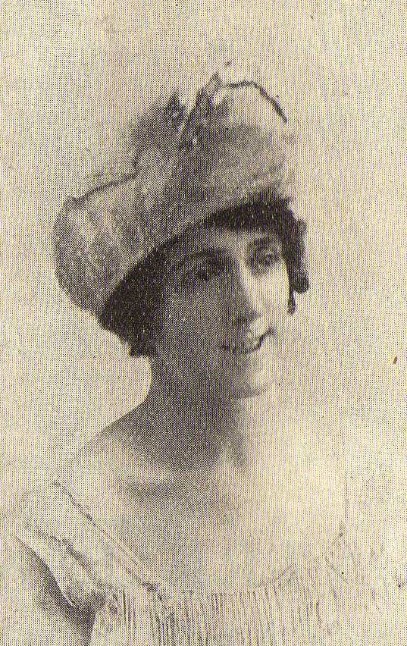
Attr: Dora Lindsay (Source: www.collinsvariety.co.uk)
Attr: Image © Mirrorpix/Reach Licensing.
Daily Record - Thursday 25 November 1915
Image created
courtesy of THE BRITISH LIBRARY BOARD.
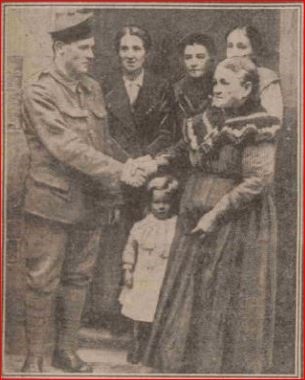
The following day, 24 November, Robert was able to catch up
with his parents and sisters for the first time since his return and visited
them at 84 Commercial Street in Pathhead. He was given wonderful reception by
neighbours, who had created a gala feeling by decorating their doors and
windows with flags and bunting. His appearance soon drew a crowd of
well-wishers wanting to shake his hand in congratulations.
One person who was missing from Robert’s welcoming group was
his younger brother, John. At this time, John was with the Royal Army Medical
Corps based in Malta.
Robert was soon off again and headed for his former school
of Pathhead, not far from his parents’ home. There, he met his old headmaster,
Mr John Christie, and visited several classrooms, where he was cheered by the
young pupils. As a mark of the honour Robert had bestowed on the school, Mr
Christie presented him with a marble clock.
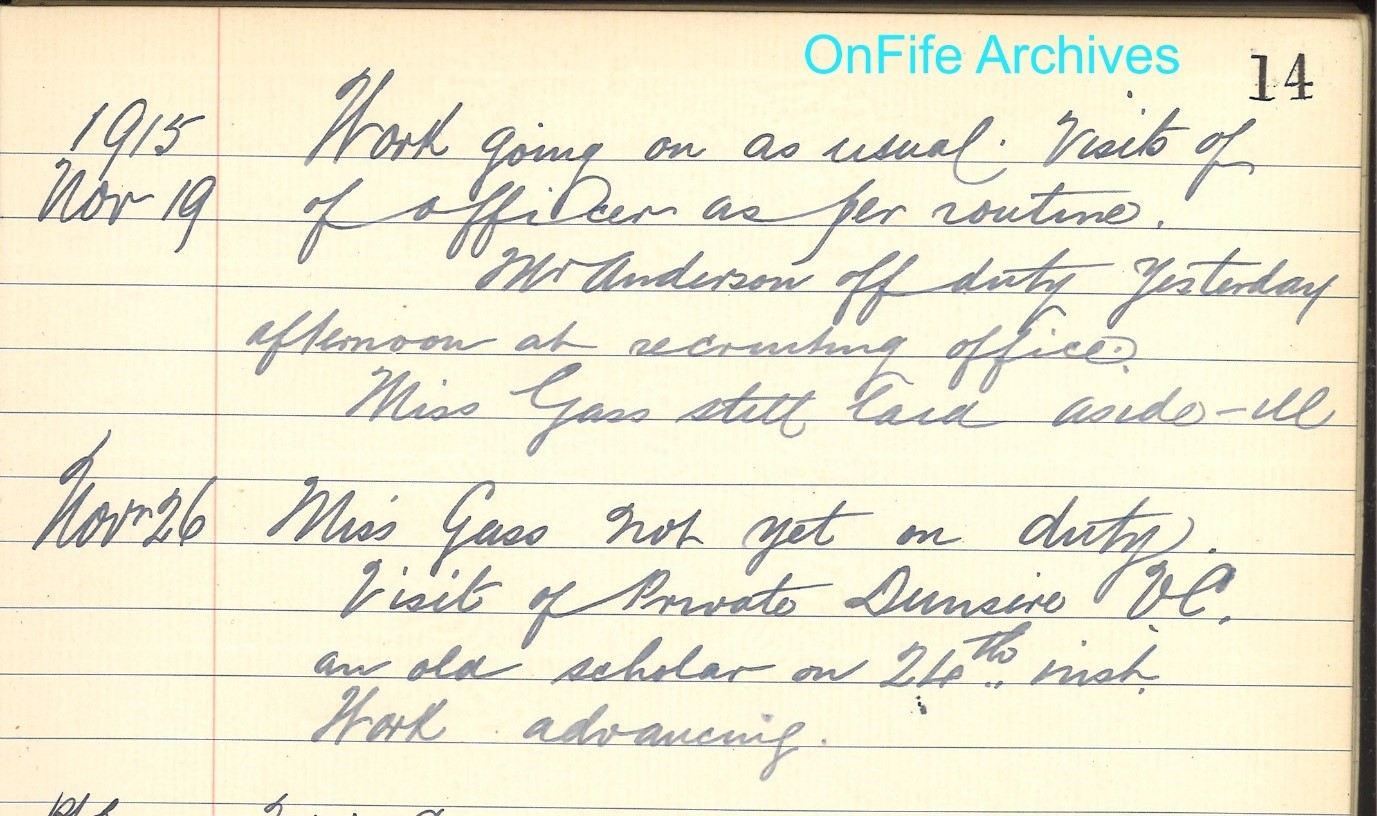
Robert’s visit was briefly documented in an entry in the
Pathhead School Diary, dated 26 November 1915, 2 days after his visit.
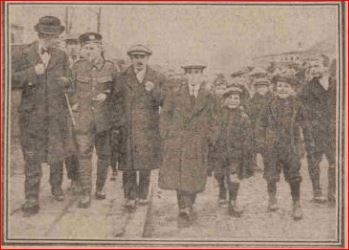
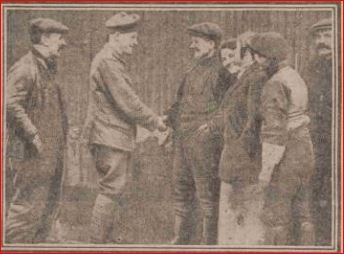
The children then accompanied Robert on his visit to meet up
with his ex-mining colleagues at the Pannie Pit, part of the Dunnikier colliery
complex. The photographs below show Robert with the pupils and former
colleagues. Robert appears to be relaxed and at ease in their company. He would
also have the opportunity to meet up with former Dunnikier Colliery Band
players, who played a significant part in future ‘celebratory’ occasions.
Attr: Image © Mirrorpix/Reach Licensing. Daily
Record - Thursday 25 November 1915
Image created courtesy of THE BRITISH LIBRARY BOARD.
Attr: Image © Mirrorpix/Reach Licensing. Daily
Record - Thursday 25 November 1915
Image created courtesy of THE BRITISH LIBRARY BOARD.
Thursday, 25 November 1915: Fundraising Events
During his home trip Robert was asked to events that
supported soldiers at the front or those that had been wounded. An example of
this was the Wemyss Parish Soldiers’ and Sailors’ Comforts Fund, of which
Robert was a future beneficiary.
Thursday, 25 November was a day for such causes. In the
morning Robert travelled the short distance to the Rechabites Hall in
Buckhaven, for an exhibition and sale of flowers. Major Cameron of the 6th
Royal Scots thanked the ladies who had prepared the event for all they were
doing towards increasing the comforts for men in their billets. The proceeds of
the sale of work were donated to the Red Cross and Blinded Soldiers’ Funds.
Robert would have appreciated that generosity.
Robert joined Major Cameron and Provost Rose on the platform
and was called upon to say a few words of thanks. During the sale, Robert got
back in his own comfort zone when he played several violin selections. He was
doing his bit in a very different way but for a very valuable purpose. To add
to the success of the day, Robert raised 25/- (£125 today) with sales of his
autograph. The sale was judged to be a success with an amount of nearly three
figures being realised.
A second event was advertised in The Leven Advertiser &
Wemyss Gazette on the day of a concert–lecture featuring Mr Allan Beveridge and
Private Robert Dunsire VC, with another violin selection, and took place in
Methil Cooperative Hall. Again, Robert did his bit for wounded soldiers and
sailors. The target for that day’s fundraising was the Funds of Methil United
Work Party. Local communities had taken up a massive challenge to help soldiers
and sailors everywhere.
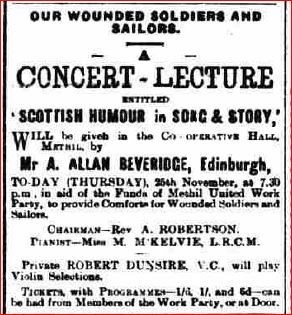
Leven Advertiser & Wemyss Gazette - Thursday
25 November 1915
Newspaper image © The British Library Board. All rights
reserved.
With thanks to The British Newspaper Archive
(www.britishnewspaperarchive.co.uk).
Robert Anderson Dunsire VC celebrated his 24th Birthday on
Friday, 26 November, but had limited opportunity to put up his feet and relax,
as he headed back to Pathhead and Kirkcaldy. Robert visited Sinclairtown
School, where he’d spent the last three years of his school life before leaving
to work in the mines, firstly at the Pannie Pit/Dunnikier Colliery. This
comprehensive entry from Sinclairtown School Diary gives a full explanation of
his visit. Just as at Pathhead earlier in the week the pupils, were granted a
half-day holiday. Mr Anderson presented the ‘gallant soldier’ with a handsome
silver-mounted walking stick as a gift from all the staff.
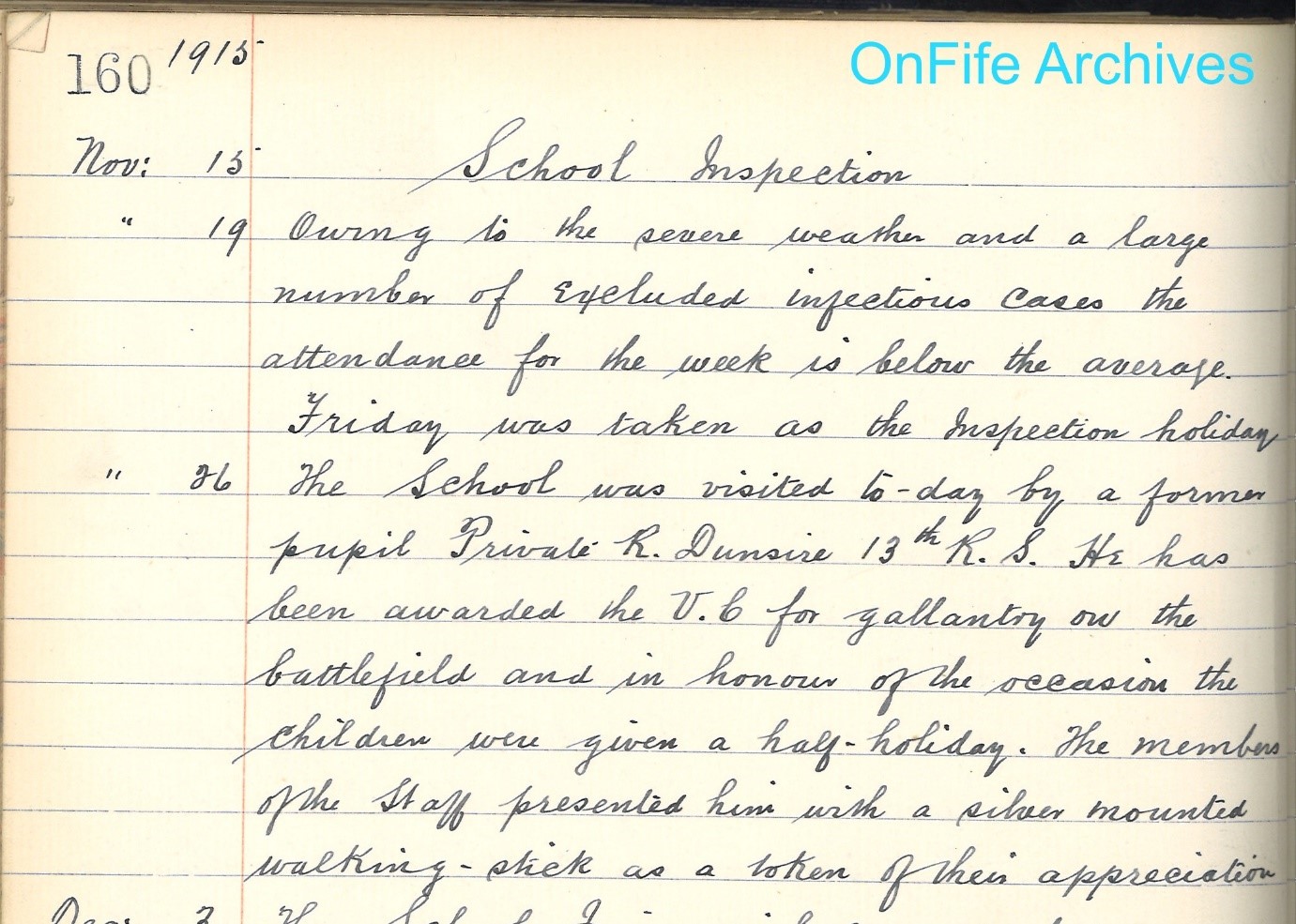
Attr: ONFife Archives
Robert’s birthday was not his own. He had to prepare for
another more formal event – an evening reception at the Corn Exchange Pavilion
in Market Street, Kirkcaldy. He had been invited to this event by Mr Mandel
Pearson, lessee of the property, that had only re-opened on 16 August 1915,
after major alterations and renovations. This was an event to introduce Robert
to the citizens of Kirkcaldy, and was hosted by Sir Robert Lockhart, Provost of
the Royal Burgh.
The red carpet was rolled out for Robert when, with his
mother and father and other relations, he was taken by car by Mr Pearson to the
Corn Exchange Pavilion. The Dunnikier Colliery Band played and marched from his
parents’ home in Commercial Street to Market Street.
The Fifeshire Advertiser of 27 November reported that: ‘On
arrival of Private Dunsire at the entrance of the Pavilion he was lifted
shoulder-high in front of the band and a flashlight photograph of the scene was
taken’. An enjoyable programme of entertainment included a poem – ‘Private
Dunsire VC’ – written and delivered by William Gamble. Kirkcaldy Provost, Sir
Robert Lockhart, appeared on the platform with other luminaries, including
local baillies, Robert’s uncle, Peter Dunsire, and Mr John Clarke, Robert’s old
headmaster at Pathhead School.
A few lines later The Advertiser reports that: ‘Two members
of Dunnikier Colliery Band, one of who wore two medals carried Private Dunsire
shoulder-high on to the platform, while the audience rose to its feet and
cheered enthusiastically’. This incident was photographed and appeared in The
Daily Mirror of 1 December 1915 as Dunnikier Colliery Band played ‘See the
conquering Hero comes’.
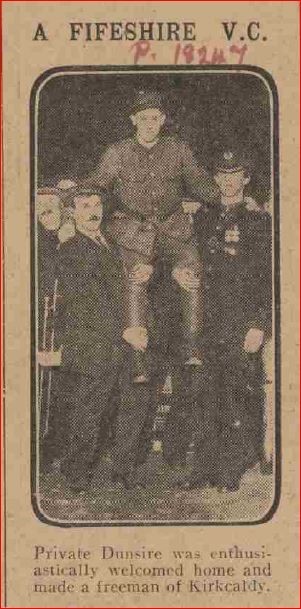
Attr: Image © Mirrorpix/Reach Licensing. Daily Mirror – Wednesday1 December 1915
The Provost’s comments referred to Robert’s formative and
working years in Kirkcaldy, claiming him as The Lang Toon’s VC, but noted that
he must remember the small neighbouring friendly burgh of Buckhaven had also
claimed Robert as a native, and justly so! He announced that the Council had
agreed to confer the Freedom of the Burgh of Kirkcaldy on Robert, placing him
alongside many illustrious sons of Kirkcaldy. This honour had only been
conferred on 10 previous occasions in 100 years.
Robert stood to reply as the whole room gave him a
‘memorable ovation’, accompanied by extended loud cheering. He stated that he
was ‘a citizen of Kirkcaldy’, having spent most of his life there. Once more,
he made his oft-repeated appeal for more young men of Fife to come forward to
serve their country and join him in France. He was his usual unassuming and
modest self as he thanked them for the ‘great and unexpected reception that had
honoured him that night’, and for ‘their expressions of admiration for a poor
private soldier who only did his duty as any soldier ought to do’. To very loud
cheers he concluded: ‘That was all – I only did my duty’.
The Provost called for three hearty cheers for ‘Private
Robert Dunsire VC, the man who did his duty.’ This was followed by a hearty
rendition, led by two sailors in the front row of ‘For he’s a jolly good
Fellow’. I can only add, ‘and so say all of us’.
Another photographic opportunity arose when, in a group of
nearly twenty, Robert, along with his mother and father, sisters and brothers,
nieces and nephews, was put on the stage and a photograph taken. Unfortunately,
I have been unable to trace a copy of this unique and special photograph.
Before Robert left to even more cheering and attempts at handshakes from the
admiring audience, Mr Pearson of the Pavilion presented Robert with a purse of
gold.
There is little doubt that Robert’s ‘enjoyment’ of this
remarkable day was somewhat tempered by Kate’s reported illness that Robert
said lasted most of the time he was home. He was soon on his way back to the
relative peace and calm of his Denbeath home.
Over those few days Robert must have been stunned by the
enormity of the impact of his act of valour. He seemed to take it all in his
stride with not a whiff of self- aggrandisement. It had been a very special
24th birthday for a very special person.
Saturday, 27 November 1915:
Football match at Den Park
Today, there was an eagerly awaited second leg of the first
round of the Fife Cup between Denbeath Star and Glencraig Celtic. The first leg
had been a 0–0 draw so there was much to play for when the current holders of
the Cup came to Denbeath. It was a cold day and the game was played on a hard
pitch.
Robert had agreed to kick off the match at the invitation of
Denbeath Star. A collection of 15s 3d (about £100 today) was taken on behalf of
the local Red Cross Fund. A large crowd was expected for the football and to
pay tribute to Robert, one of their own.
Half-time entertainment was provided by the Royal Scots
2/4th Battalion (Queen’s Edinburgh Rifles) Territorial Force Band. This
battalion of the Royal Scots was raised in Edinburgh in September 1914, saw
service in Scotland till March 1916, but never crossed the Channel to France or
elsewhere and was disbanded in July 1918.
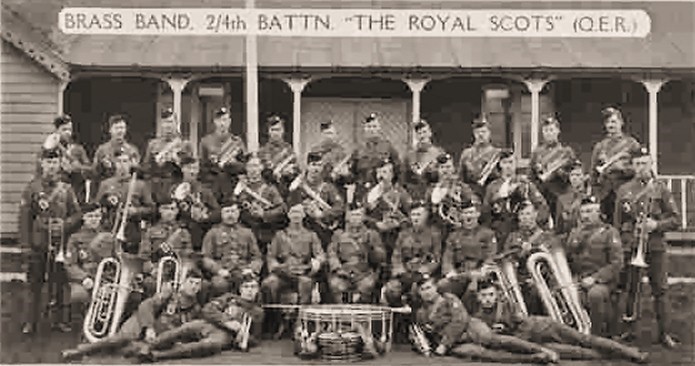
The match was a triumph for Denbeath Star and their forward,
Cunningham, who was being scouted by Raith Rovers manager, John Richardson.
Cunningham scored a hat-trick to give Star safe passage into the next round of
the Fife Cup with an aggregate 3–0 victory. It was not an inspiring game from
all reports, but it certainly went down in local history, and Denbeath Star
went on to win the Fife Cup that season.
At half-time, John Farmer, who had recently taken over the
licence of the White Swan Hotel from Mr Campbell, presented the local VC with a
wrist watch, supplied by Mr Masterton of Leven. Masterton still exists as a
local jeweller in Leven today. This was a much more relaxing day for Robert and
he was able to return to the comfort of his own home a few minutes after the
match was over. Another duty done!
Sunday, 28 November 1915: Home
Time rolled on as Robert had been granted 10 days’ furlough when Colonel Maclear first sent him home after the news broke of Robert’s being awarded the Victoria Cross, but Mr Leslie, Town Clerk of Buckhaven, Methil and Innerleven Council, had applied to the War Office to have Robert’s leave extended, on the basis of the number of recognition events that had been planned, particularly a local event that was receiving excellent support. In addition, there was still no news of when Robert Dunsire VC was to go to Buckingham Palace to receive his VC medal from King George V.
At the War Office, plans may have already been known to send
the 13th Battalion of the Royal Scots as the Corps IV Reserve in the near
future, but that is only my personal speculation.
Robert spent the rest of the day in the knowledge that the
next day he would join another elite group in Kirkcaldy Burgh. No doubt he
spent part of the day getting his uniform in order. It was certainly a time for
Robert to reflect on very memorable and unexpected few days in his life.