oxygen domain was triggered too early. This is usually an indicator for some code in the plugin or theme running too early. Translations should be loaded at the init action or later. Please see Debugging in WordPress for more information. (This message was added in version 6.7.0.) in /home/rdunsire/public_html/wp-includes/functions.php on line 6260wordpress-seo domain was triggered too early. This is usually an indicator for some code in the plugin or theme running too early. Translations should be loaded at the init action or later. Please see Debugging in WordPress for more information. (This message was added in version 6.7.0.) in /home/rdunsire/public_html/wp-includes/functions.php on line 6260Less than six months after his marriage to Kate, Robert
Dunsire made another life-defining decision, and on 6 January 1915, he
travelled from Denbeath to Kirkcaldy, to enlist in Kitchener’s Volunteer Army.
His chosen regiment was the Royal Scots.
He was among 100 early recruits in Kirkcaldy recorded in the
Roll of Honour in the 9 January 1915 edition of The Fife Free Press &
Kirkcaldy Guardian.
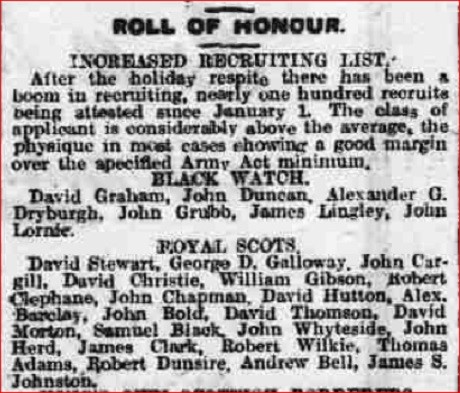
Attr: Image © Johnston Press plc.
Image created courtesy of THE BRITISH LIBRARY BOARD.
This must have been a challenging decision for any new
recruit. Newspapers were already reporting the deaths of local members of K1 –
the first 100,000 recruits to Kitchener’s Army – and of regular soldiers
serving before Britain had declared war on Germany on 4 August 1914.
Among the Regulars was his wife Kate’s brother, Ralph Pitt,
who had enlisted with the Scots Guards at Berwick on Tweed, as an 18-year-old.
At the time of Robert’s enlistment, Robert and Kate were already aware that
Ralph was missing, but there was no confirmation of his body being found.
Denbeath was seen as a loyal village with 800 of its 2,000
inhabitants having enlisted with the army or navy. A report from The Evening
Telegraph, from 9 May 1915, emphasises the strength of support. It explained
that Mr and Mrs Thomson from Denbeath had received a letter from the King
congratulating them on their six sons having enlisted. The local Gaiety Theatre
in Denbeath was doubling as a recruiting office.
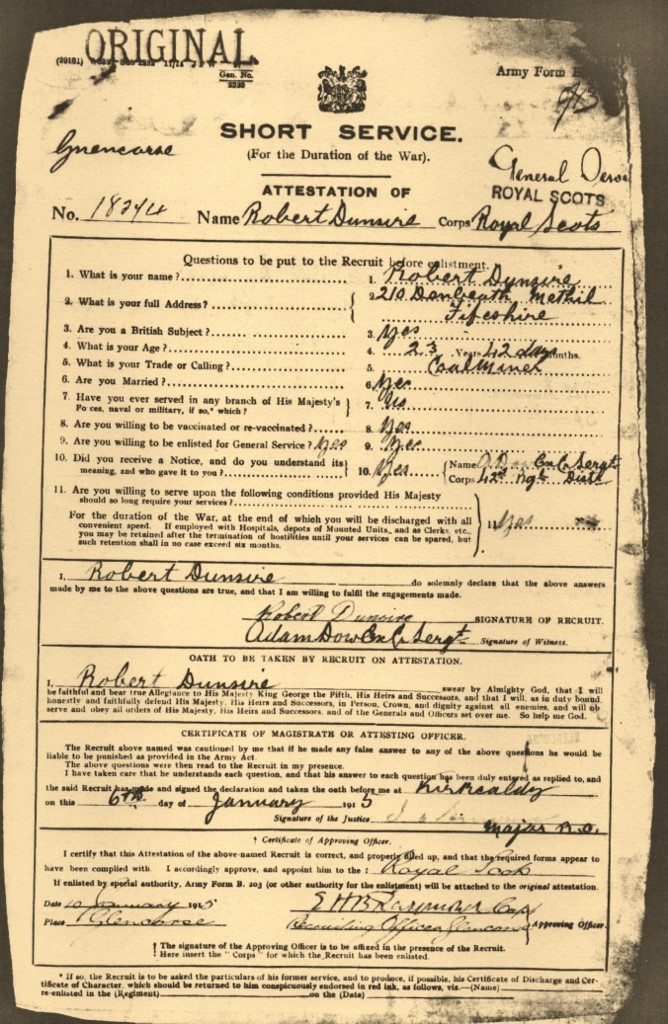
Attr: https://www.ancestry.co.uk/cs/start-military World War 1 Service Records.
The National Archives Crown Copyright
Robert Anderson Dunsire was now known as Private Dunsire,
18274, of D Company of the 13th Battalion of the Royal Scots. Robert safely
negotiated his recruitment medical. He was 5 ft 5½ ins tall, weighed in at 134
pounds, and had a heart rate of 78 bpm. His overall health was documented as ‘good’.
None of this is a surprise given his activity as a hewer at the coal face.
The first page of Robert’s service record indicates that his
early service and training took place at the Royal Scots Depot at Glencorse
Barracks, near Penicuik, in Midlothian before moving on in February 1915 to
billets at Basingstoke.
During Robert’s period of recruitment soldiers had a choice
in the Regiments they could join. Robert was soon to be proudly wearing the
regimental badge of The Royal Scots on his cap. The 13th Battalion of The Royal
Scots was part of 15th (Scottish) Division – part of K2 that was created by
Army Order 382 of 11 September 1914. K2 was made up by Divisions 15 to 20. 15
Division was to form part of 45 Brigade.
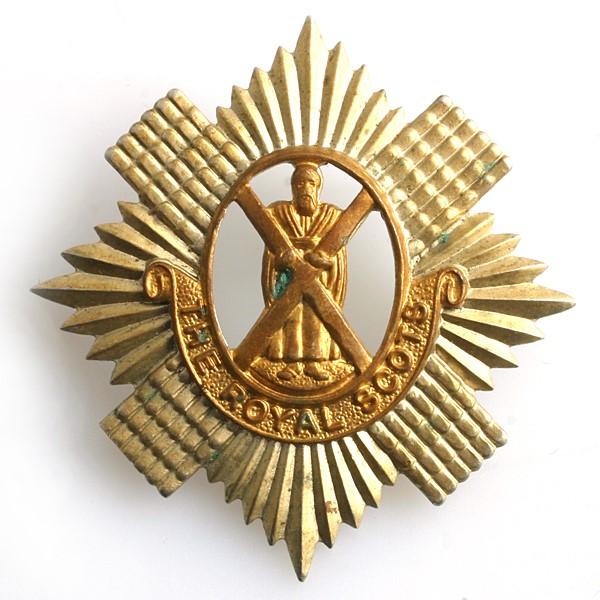
Robert spent his first 184 days preparing for his first trip
with the British Expeditionary Force to France. Much of the 70 hours a week
training (Sunday was a rest day) took place in Wiltshire, along with other
regiments and battalions. Training and lack of weaponry is well documented in The
Fifteenth (Scottish) Division 1914–1919 by Lieutenant-Colonel J. Stewart D.S.O.
and John Buchan (former resident of Pathhead, Kirkcaldy). Most of the
previously available equipment had been taken away by K1 when they moved to
Europe. Robert and 45 Brigade were based at Draycott Foliat Camp from late
April 1915. This camp had the Chiseldon postmark and soon became known as
‘Chiseldon (near Swindon)’. As Stewart and Buchan stated:
Billets were things of the past and the final instruction in
Musketry and Brigade and Divisional Training commenced. Long and arduous
marches put finishing touches to the previous work. Spring and early Summer of
1915 were ideal for training and as the days lengthened more and more work was
accomplished in the twenty-four hours. By this time real Lewis guns had taken the
place of the wooden dummies. New leather equipment had been issued and Units
were completely fitted out.
Source: The Fifteenth (Scottish) Division 1914–1919
(Stewart and Buchan,
1926) Published by William Blackwood, Edinburgh
A layout of the Camp at Chiseldon is shown in the following
plan.
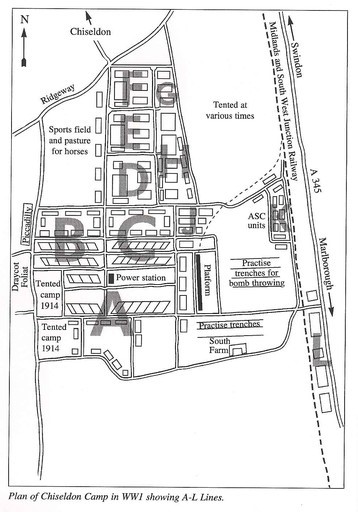
The Camp had its own Railway Station and would be a
departure point for soldiers starting their journey to the SE Coast for their
Cross-Channel sailing to France. Newspapers reported that Robert had been
singled out for praise by battalion officers, who were particularly impressed
by his ‘great proficiency in trench-digging and dugout- making’. On one
occasion the battalion was paraded to see his work. Robert was already being
noticed for his contribution.
A red-letter day for the 15th Division is recorded as 21
June 1915, when it was assembled at Sidbury Hill and inspected by King George
V. This would probably be Robert’s first personal view of the King as the 15th
Division paraded smartly before him. As training drew to a close, soldiers were
allowed home on leave, to return when they were mobilised on 4 July 1915.