oxygen domain was triggered too early. This is usually an indicator for some code in the plugin or theme running too early. Translations should be loaded at the init action or later. Please see Debugging in WordPress for more information. (This message was added in version 6.7.0.) in /home/rdunsire/public_html/wp-includes/functions.php on line 6260wordpress-seo domain was triggered too early. This is usually an indicator for some code in the plugin or theme running too early. Translations should be loaded at the init action or later. Please see Debugging in WordPress for more information. (This message was added in version 6.7.0.) in /home/rdunsire/public_html/wp-includes/functions.php on line 6260It was not only local men who were prepared to make
contributions to the War effort. Some women chose to go to the front to fulfil
volunteer roles; for example, in the Scottish Women’s Hospitals (SWH). Women
made an enormous contribution at home as they backfilled a variety of jobs that
had been left by male volunteers, who had responded to Kitchener’s clarion call
to come forward. They also worked in jobs that supported the men at the front
by working in manufacturing, including in ammunition factories, and
agriculture.
The Scottish Women’s Hospital (SWH) movement was founded in
1914, soon after the outbreak of war, in response to the rejection of medical
women joining the Royal Army Medical Corps. Elsie Inglis from Edinburgh was its
founder.
The British Red Cross was hampered by War Office regulations
regarding the work of women, and so was unable to help Elsie Inglis and her new
movement, thus the SWH had to act independently. However, this did not stop
action by women from Robert’s local area.
The first French unit of the SWH arrived in France in
December 1914, and formed a base hospital at Royaumont Abbey, 12 miles from
Chantilly, on the outskirts of Paris. The first of several Serbian units
followed soon after. They provided nursing services, doctors, ambulance
drivers, cooks and orderlies.
An early example was that set by the Misses Gray of Oakley
Lodge, Leven whose decision to travel was announced in the Leven Advertiser
& Wemyss Gazette of 12 November 1914.
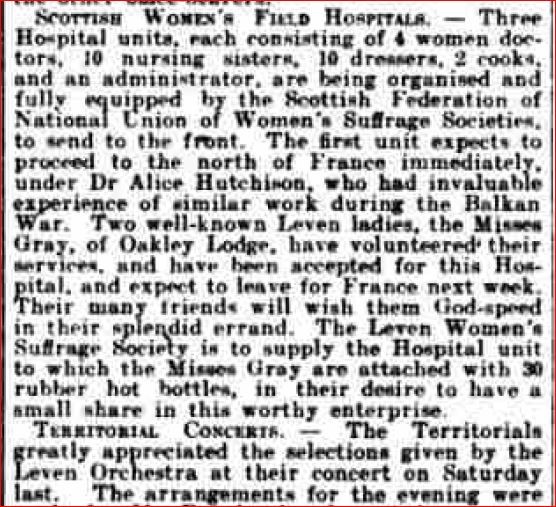
Attr: Newspaper image © The British Library Board. All rights reserved.
With thanks to The British Newspaper Archive
(www.britishnewspaperarchive.co.uk).
An article in the Dundee Courier of 20 November 1914
explained that Lady Eva Wemyss had approached the British War Office with an
offer to equip and take a field hospital of 35 beds to France. At that time, it
was expected that the hospital would be at Nantes on the banks of the River
Loire.
It was the 11 February 1915 edition of the Leven Advertiser
& Wemyss Gazette finally reported that Lady Eva and her entourage were
heading for Chateau du Fayel, west of Soissons and north of today’s Charles de
Gaulle Airport. The agreement to create the field hospital was made with the
French Ambassador in London rather than the British War Office.
Her complement of staff included Nurse Hughes. According to The
British Journal of Nursing, she had been the district nurse in Pittenweem, in
the East Neuk of Fife, for two years, and had also worked at Wemyss Hospital.
Lady Eva donated a sum of around £10,000 (equivalent to £1
million today) for the building of the hospital, but many of the fixtures,
fittings and equipment were provided by donations from well-known local people
and businesses.