oxygen domain was triggered too early. This is usually an indicator for some code in the plugin or theme running too early. Translations should be loaded at the init action or later. Please see Debugging in WordPress for more information. (This message was added in version 6.7.0.) in /home/rdunsire/public_html/wp-includes/functions.php on line 6260wordpress-seo domain was triggered too early. This is usually an indicator for some code in the plugin or theme running too early. Translations should be loaded at the init action or later. Please see Debugging in WordPress for more information. (This message was added in version 6.7.0.) in /home/rdunsire/public_html/wp-includes/functions.php on line 6260The 31 January 1915 entry in the 13th Battalion War Diary
records a simple but awful report: ‘Same trenches. Private Dunsire VC mortally
wounded yesterday by enemy trench mortar.’ The following extract from 46
Ambulance Station War Diary for Sunday 30 January 1916 makes grim reading.

Attr: The National Archives' reference WO 95/1931/2 © Crown
Copyright
It was reported that, some minutes prior to the tragic event
of 30 January 1916 that led to Robert Dunsire VC and James Sproul of the 13th
Battalion of the Royal Scots being carried in from the Hulluch Alley trench, both
men had been together in the trenches with colleagues having a singsong.
A newspaper report, attributed to Kinghorn born Captain
Charles Yule of the 13th Battalion, the Royal Scots, is more specific and explains
that moments before the German trench mortar landed next to Robert and James
Sproul, they had been singing ‘Keep the Home Fires Burning’.
A 1917 recording of this popular song sung by John McCormack
can be listened to at https://youtu.be/WvuCaLRcgh4
.
An article from The Yorkshire Post and Leeds Intelligencer
illustrated how far and wide this tragic event was covered, Captain Yule refers
to Robert’s status as lance corporal with the imminent probability of promotion
to Sergeant in the new machine-gun sections that were launched as a specialist
skills group in February 1916. Yule stated that, ‘Dunsire was recognised as one
of the finest soldiers in the battalion.’
Captain Yule explained in other reports that Lance Corporal
Dunsire was out of his machine-gun section role at the time, but was soon
returning from his current role in the trenches. This confirms Robert’s
promotion and also suggests that Robert was among the elite Scottish miners who
had been involved in the tunnelling of galleries so that mines could be used to
destroy enemy galleries above them, using underground warfare.
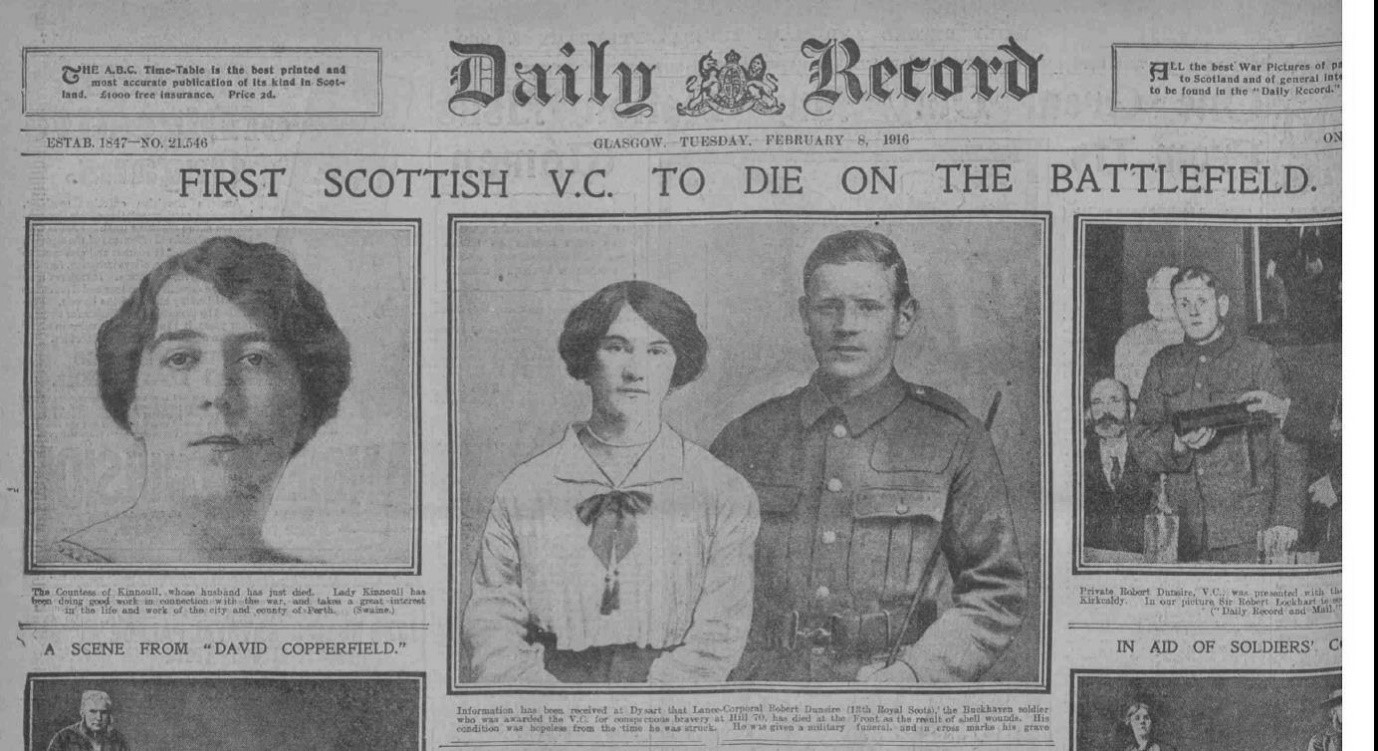
Attr: Daily Record - Thursday 8 February 1916 Image
© Mirrorpix/Reach Licensing.
Image created courtesy of THE BRITISH LIBRARY BOARD.
Many newspapers, both local and around Great Britain,
carried the story and circumstances of Robert’s death. In some instances, where
soldiers had written home, the content of their letters about the incident had
been released to the press. In many cases, the content also revealed that there
was no doubt about the respect that Robert had enjoyed among his fellow
soldiers as a person and as a soldier.
The news was received in Commercial Street in Kirkcaldy by
Robert’s parents shortly after they had received a postcard stating that he was
well and would soon be facing the music again.
Sir Robert Lockhart, Provost of Kirkcaldy, had also just
received a letter from Robert some 10 days earlier, giving an update on his
activities and passing on his best wishes to the provost, his wife and other
burgh officials stating: ‘Hope this finds you, as it leaves me, in the best of
health’.
However, there was one more very important person to receive
the news – Kate, Robert’s wife of 18 months. The story of Robert’s death was
fully covered in the Fife Free Press, & Kirkcaldy Guardian - Saturday 12
February 1916. Kate apparently heard the news when she called on a neighbour to
enquire about a sickly child after attending a local PSA (Pleasant Sunday
Afternoon) meeting. An older child had purportedly burst into the room saying ‘Oh
mither, they say Bob Dunsire’s killed’. The words were out before she saw who
was visiting. A visit from Kirkcaldy by her brother-in-law, Thomas Dunsire,
from Kirkcaldy confirmed the news. He had had personal confirmation from
Captain Yule.
Kate had just received a letter from her husband and she
thought he was in the comfort of the rest camp. She believed that the letter
had been posted after he left the firing line. To add to her grief, Kate’s
parents had received formal confirmation from the War Office two days earlier that
her brother, Ralph Pitt, who had been posted missing near Ypres in November
1914, must now be considered dead.
Captain Yule stated that Robert and James Sproul were given
a military funeral. The funeral party had been formed by the Gordon
Highlanders. As explained by Private Jack Williamson of the 9th Gordon
Highlanders, ‘The Flowers of The Forest’ had been played over Robert’s grave
just as it was played again by a lone piper at the unveiling of Robert’s
commemorative VC paving stone at Toll Park, Buckhaven, on Saturday, 26
September 2015, on the 100th anniversary of his act of valour. Kate’s lasting
tribute to her husband appeared in The Leven Advertiser and Wemyss Gazette on
17 February 1916.
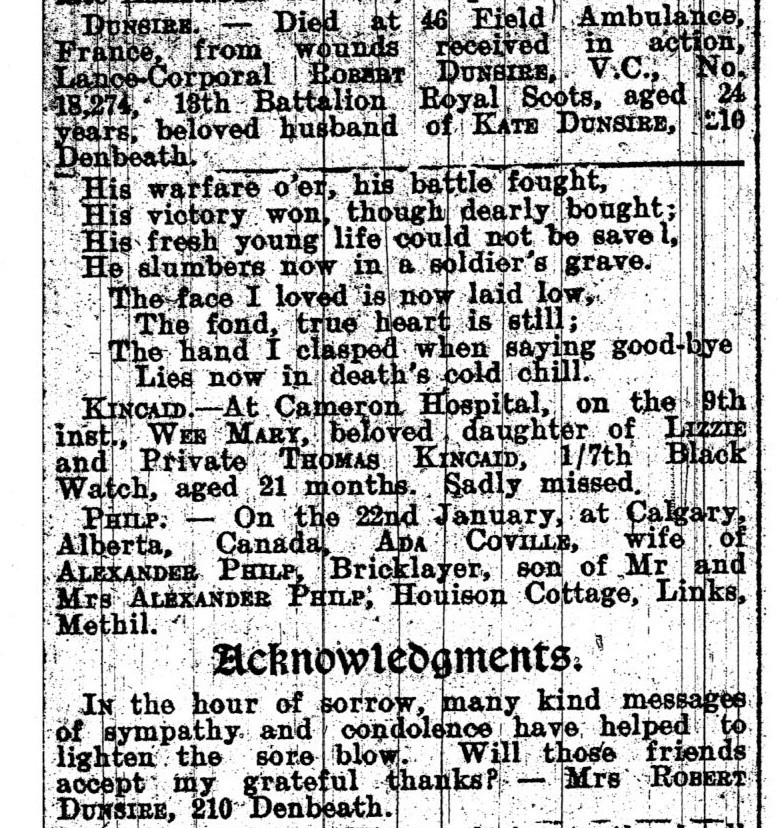
Leven Advertiser & Wemyss Gazette - Thursday
17 February 1916
Newspaper image © The British Library Board. All rights
reserved.
With thanks to The British Newspaper Archive (www.britishnewspaperarchive.co.uk).
As Robert died on Service in France no formal Death
Certificate was issued in Scotland. The only existing record of Robert’s death is
filed in the National Records of Scotland as a Minor Record. It consisted of a
list of soldiers who were killed in action, died of wounds or presumed dead.
Robert was designated as Died of Wounds and continues to be listed as a Private
with a handwritten comment in the left margin – ‘Victoria Cross’.
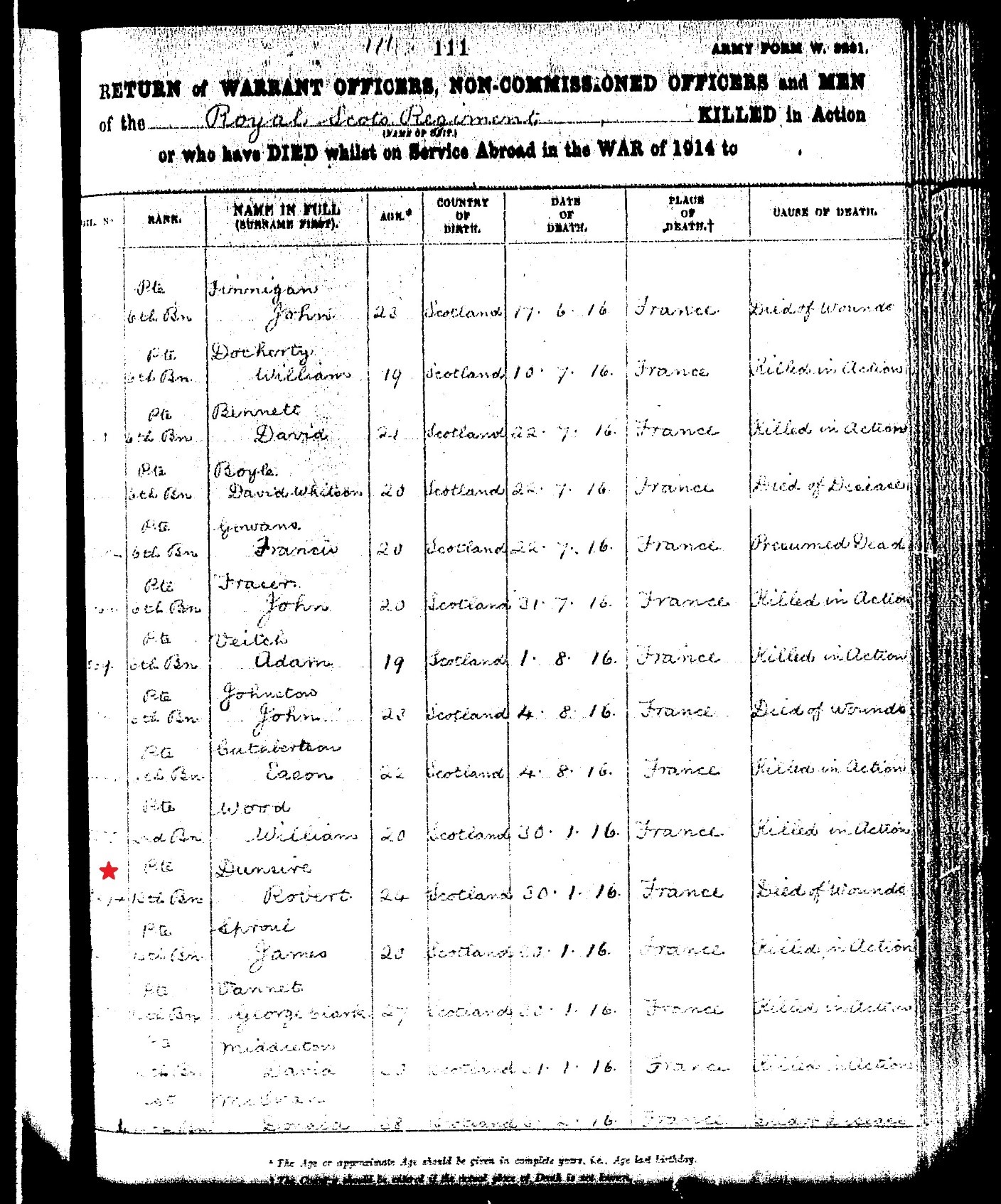
Minor Records - Attr: Crown Copyright, National Records of Scotland
The contents of Robert’s pockets were eventually returned to
Kate. An informal list note is handwritten on Page 7 of Robert’s Service Record
dated May 1916. The contents were to be sent to Kate at 210 Denbeath.
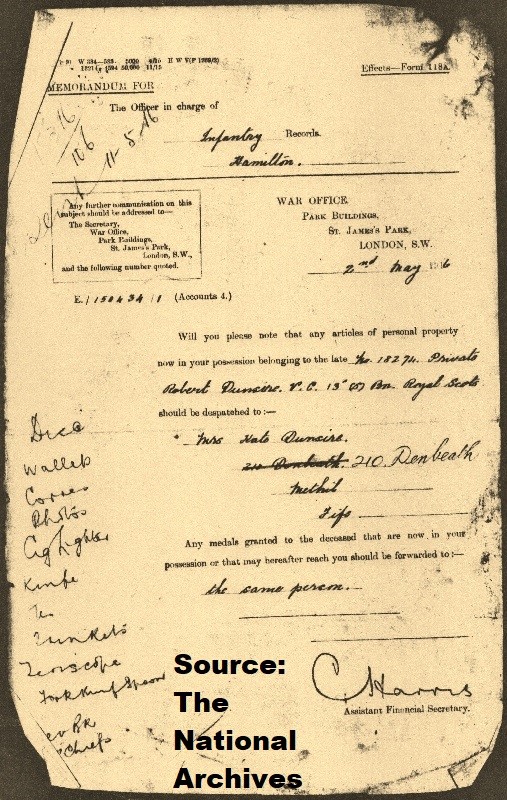
Attr: https://www.ancestry.co.uk/cs start-military World War 1 Service Records
Crown Copyright -
The National Archives of the UK (WO363): Public Records Office
All soldiers created wills before heading for action in the
field. A summary is held on Robert’s Service Record and Robert’s handwritten
version is held in The National Records of Scotland. The Service Record version
appears below.
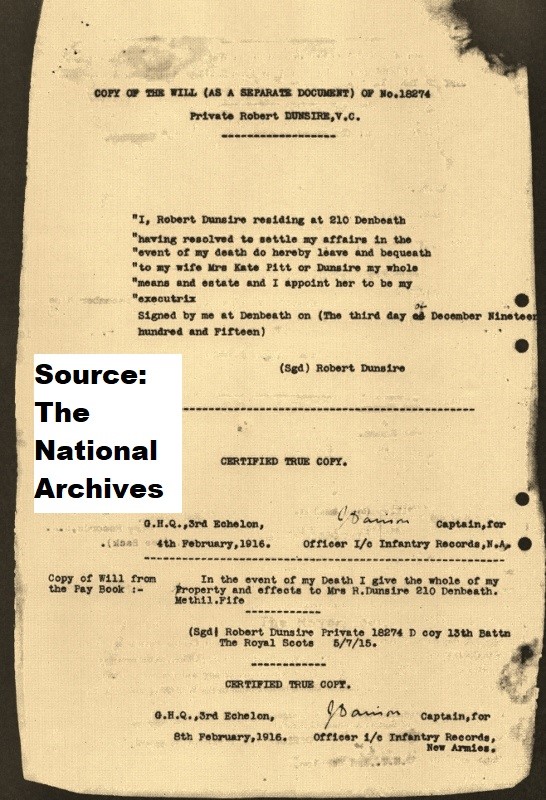
Attr:
https://www.ancestry.co.uk/cs/start-military World War 1 Service Records
Crown Copyright -
The National Archives of the UK (WO363): Public Records Office
In all of
this sadness it is ‘positive’ to note that Kate was awarded a pension from 14
August 1916.
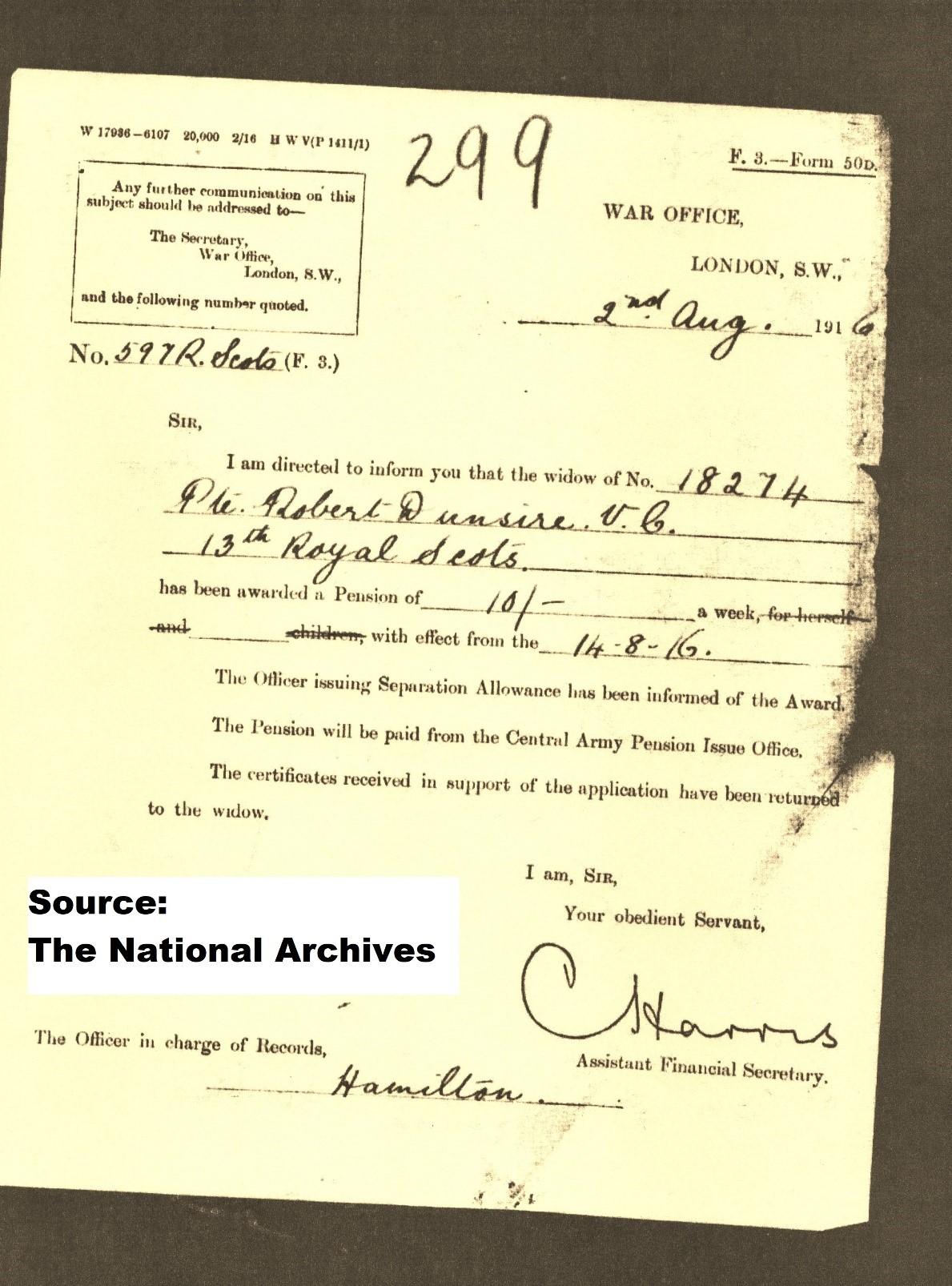
Any outstanding pay or allowances that were passed to Kate,
in accordance with his will, are documented in Robert’s ‘Soldier Effects’. The
entry for Robert Dunsire VC shows that Kate, as the sole legatee, was sent £7
5s (shillings) and 4p (pence) on 2 May 1916 and was paid a War Gratuity of £3
10s on 23 August 1919.
Poignantly, it had been the Diamond Anniversary of the
Victoria Cross on 29 January 1916. Less than 700 had been awarded up to this
time and the anniversary marked the date when Queen Victoria had initially signed
the Royal Warrant that instituted the award.
Though Robert’s death was reported in The Daily Record as
the first Scottish VC to die in the battlefield Robert was in fact the second.
The death of the first recipient would only be revealed to his family on 11
February 1916 and only reported sparingly in the press on 12 February 1916. The
first of the five Fife-born soldiers to be awarded the Victoria Cross in World
War I – Sergeant David Finlay VC of 2 Battalion of the Black Watch, born in
Guardbridge – had been killed on 21 January 1916. David Finlay VC was killed in
action in Mesopotamia, but has no known grave and is remembered on the memorial
at Basra, Iraq.