oxygen domain was triggered too early. This is usually an indicator for some code in the plugin or theme running too early. Translations should be loaded at the init action or later. Please see Debugging in WordPress for more information. (This message was added in version 6.7.0.) in /home/rdunsire/public_html/wp-includes/functions.php on line 6260wordpress-seo domain was triggered too early. This is usually an indicator for some code in the plugin or theme running too early. Translations should be loaded at the init action or later. Please see Debugging in WordPress for more information. (This message was added in version 6.7.0.) in /home/rdunsire/public_html/wp-includes/functions.php on line 6260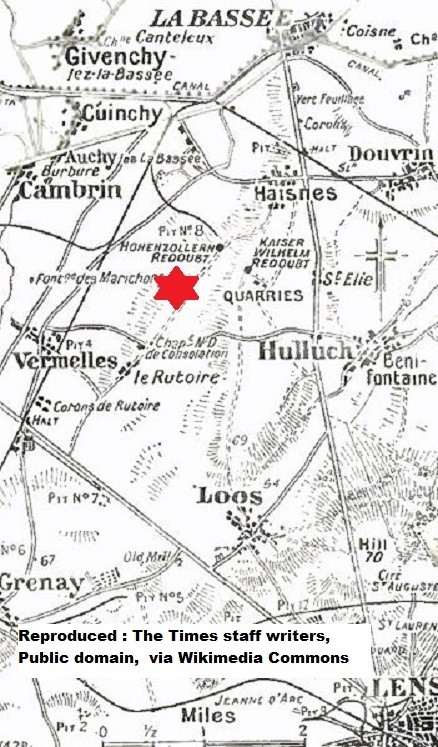
On his return to France, Robert was just in time for the
regiment moving into the Hohenzollern Redoubt Sector. On 10 December 1915, the
13th Battalion War Diary noted that the German artillery was more active than
usual. Two days later the battalion moved into Brigade support in the Vermelles
trenches. A familiar note reappeared in the War Diary about ‘raining hard’,
‘trenches wet’, so a day with just ‘mist’ was worthy of note.
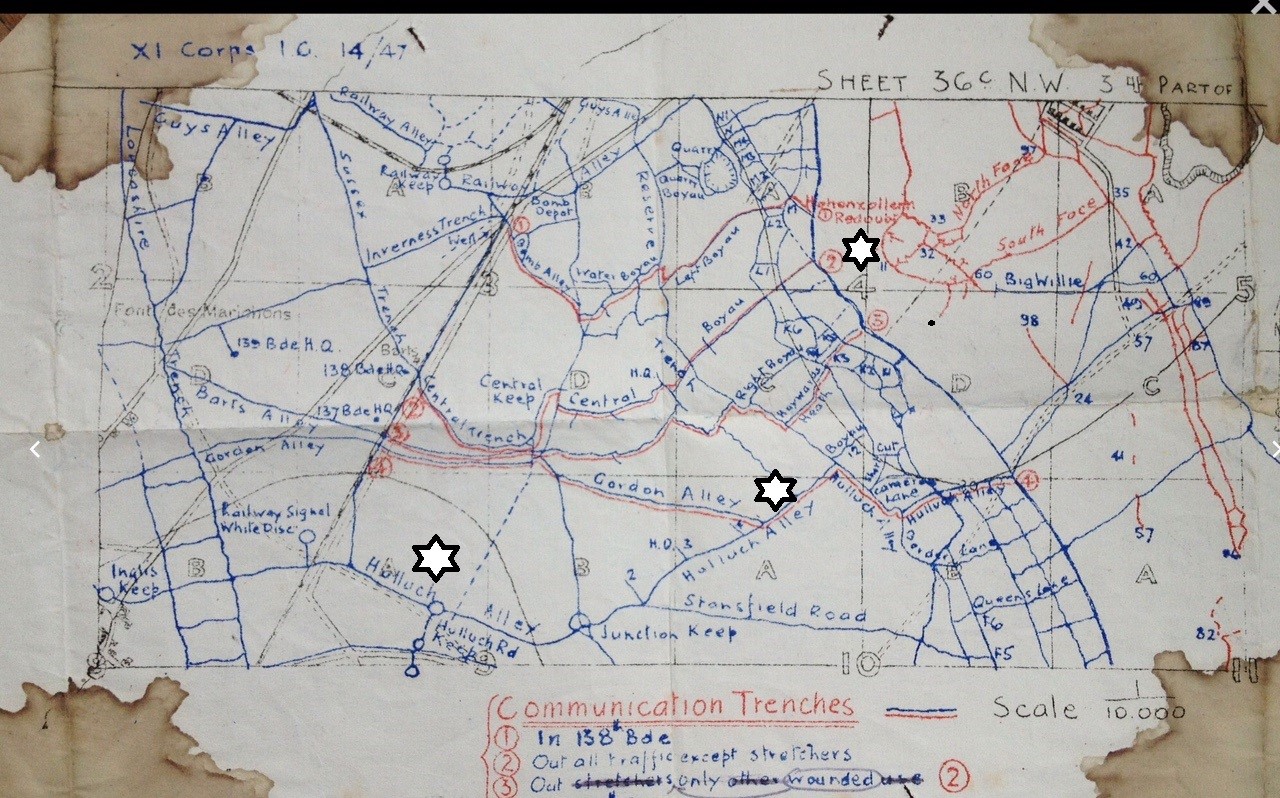
Trench Map with Hulluch Alley Communications Trench
highlighted
Trench Map with Hulluch Alley Communications Trench
highlighted
Soon the battalion was to return to Corps IV Reserve to an
area of Lillers, some 20 miles to the NW of Vermelles. They were to remain there
for a month.
The first few days in Reserve were spent cleaning up and reorganising.
Intensive trained started immediately. This ended with a major 15th Division
exercise, west of Lillers, that lasted for three days between 3-5 of January
1916. This got a big ‘thumbs-up’ from senior officers. Training and instruction
were carried out at all levels and included courses such as Signalling by
lecturers from other schools in IV Corps and other support sections.
New Year 1916 was recorded by one battalion as: ‘The
Officers saw The New Year in, but as a whole the battalion slept it in.’
Robert had his own unique experience at this time. He had
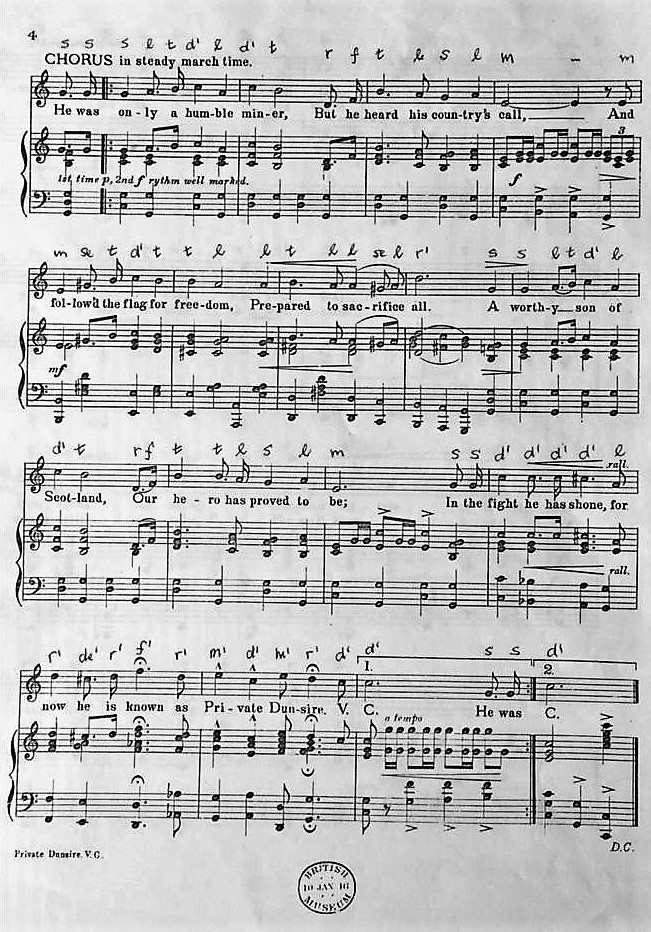
received the sheet music for a song, ‘Private Dunsire VC’, written in his
honour. The words had been written by Felix Slevin, who was well known in brass-band
circles in the south-west of Scotland, and had been the conductor of the
Creetown and Darvel Bands. The music was written by Gordon Mackenzie, whose
compositions were very popular in Scotland at that time.
Robert had had sufficient free time when demonstrating his
customary courtesy to write a letter dated 8 January 1916 which was reprinted
in The Leven Advertiser & Wemyss Gazette of Thursday 20 January
1916. He has also had the opportunity to try out the song with his colleagues.
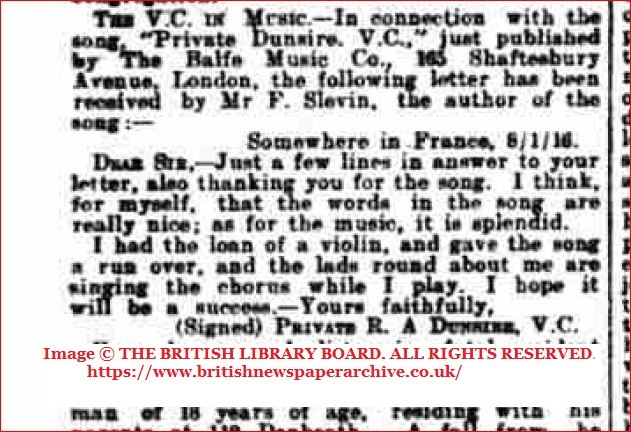
Attr: Leven Advertiser & Wemyss
Gazette - Thursday 20 January 1916Newspaper image © The British
Library Board. All rights reserved. With thanks to The British Newspaper
Archive (www.britishnewspaperarchive.co.uk).
The sheet music of Private Dunsire VC containing the chorus
is printed below.
The recording by Graeme Wilson of Kirkcaldy was made on
Robert’s own violin that was kindly loaned by David Rattray. David had restored
the violin 100 years after it had been originally presented to Robert when he
was home on leave.
However, new orders were issued on 10 January 1916. They
were on the move again having benefitted from rest periods and a thorough
opportunity to finish training and integrating the new drafts of soldiers, who
had been arriving in numbers since the Battle of Loos. The battalion
transferred by train to Noeux-les-Mines, only 3 or 4 miles from the Front. They
remained in 15 Division Reserve from 15–19 January, then in 45 Brigade Reserve
at Philosophe, till 23 January 1916.
During December and January one aspect of the conduct of the
war started to change. Evidence emerged that some of the battle activity was
beginning to move underground, though it was some time before tunnelling with
men and equipment became a feature on the front around Hulluch and
Hohenzolleren Redoubts.
Both sides were busily engaged in mining operations; each
trying to tunnel under the galleries of the other. During December 1915, the
Germans had got the upper hand with this activity. British troops had to halt their
activity and destroy new galleries. 15 Division, including Robert and the Royal
Scots, had no lack of skilled miners in its ranks who were called in to help
the Royal Engineers to construct counter galleries beneath the German galleries.
Many who helped were from the mining areas of Fife and Lanark. They were more
than willing to help with this work, even if just to break the monotony of that
time.
The divisional area was still chalky and water lay 10 to 12
feet under the surface, so was unsuitable for mining operations. However, a
little to the north, towards Hohenzollern Redoubt, daily discharges of
underground mines was a daily occurrence that was followed by fierce fighting
to take over the craters created by these explosions.
Robert was now in the Hulluch Sector, where the enemy’s
artillery was much more active than usual. There was more evidence of more
German troops moving into the area. The use of grenades and trench mortars
increased on both sides of the line. Bombing attacks occurred nightly. The 13th
Battalion Diary ‘complains’ that their own heavy artillery is not replying as
effectively.
The battalion was then back into Brigade reserve again on 26
January after 3 days in 45 Brigade Reserve. They now took up position in the reserve
British trenches and the old German front line that had been captured, then
held, during and after the Battle of Loos.
They returned to the trenches in the Hulluch Area.