oxygen domain was triggered too early. This is usually an indicator for some code in the plugin or theme running too early. Translations should be loaded at the init action or later. Please see Debugging in WordPress for more information. (This message was added in version 6.7.0.) in /home/rdunsire/public_html/wp-includes/functions.php on line 6260wordpress-seo domain was triggered too early. This is usually an indicator for some code in the plugin or theme running too early. Translations should be loaded at the init action or later. Please see Debugging in WordPress for more information. (This message was added in version 6.7.0.) in /home/rdunsire/public_html/wp-includes/functions.php on line 6260On the evening of Monday, 29 November 1915, Robert was
accompanied by his wife, Kate and his parents, Thomas and Elizabeth Dunsire, to
Kirkcaldy Town Hall. Robert was again accompanied by the Dunnikier Colliery
Band as it marched in front of the Dunsire family town car from Wemyss Tramcar
terminus at Gallatown to the town hall.
The streets were lined with cheering crowds as the band
played a selection of music that included ‘Roll of Honour’ and ‘Follow the
Drum’. The town hall was located on the High Street, close to the top of
Tolbooth Street.
The event started at 20.00 and the council chambers had been
transformed to enable long tables of refreshments and cakes for the waiting
guests. The corporation organist, Mr Gray, was at the piano as the ceremony
opened with the National Anthem, followed by three cheers.
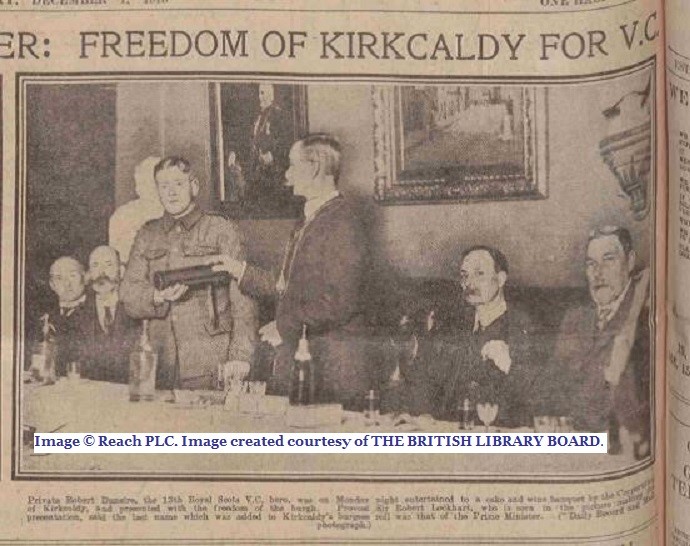
Attr: Daily Record - Wednesday 01 December 1915
Image © Mirrorpix/Reach Licensing.
Image created courtesy of THE BRITISH LIBRARY BOARD.
In his opening address, Provost Lockhart expressed his disappointment that the event was not open to more guests. He noted that, in the list of burgesses, volunteers as far back as 1644, and again in 1900 for the Boer War, had left these shores to fight on behalf of King and Country, and explained that Private Robert Anderson Dunsire’s name was joining a small but illustrious list from the last 100 years that included:
Three local gentlemen: Sir John Oswald of Dunnikier, Lord
Loughborough and Colonel Ferguson of Raith.
Richard Cobden, an apostle of free trade, known for his
opposition to the Corn Laws.
Sir William Vernon Harcourt, a lawyer, journalist and
Liberal, who had once stood for the parliamentary seat of Kirkcaldy.
Marquis of Dufferin and Ava, who made his name in the
Diplomatic Service and became the 8th Viceroy of India.
Andrew Carnegie, philanthropist.
The Rt. Hon. Herbert Henry Asquith MP, another Liberal who, by the day of Robert’s ceremony, was Prime Minister of Great Britain.
In describing Robert’s act of valour, the provost explained
how Robert ‘calmly and deliberately’ left the comparative safety of the
trenches to make his two successful rescue attempts. ‘It was deeds like these
that rose to the highest ideal of chivalry, touched the noblest aspiration of
the race, absolute and fearless sacrifice’. The provost and magistrates then
signed the Burgess Ticket before, to great applause, presenting it to Robert
while expressing the hope he would return safely among them again. Once more
the words of ‘For he’s a jolly good Fellow’ echoed round the room in
recognition of that fine young and modest soldier, Robert Dunsire VC.
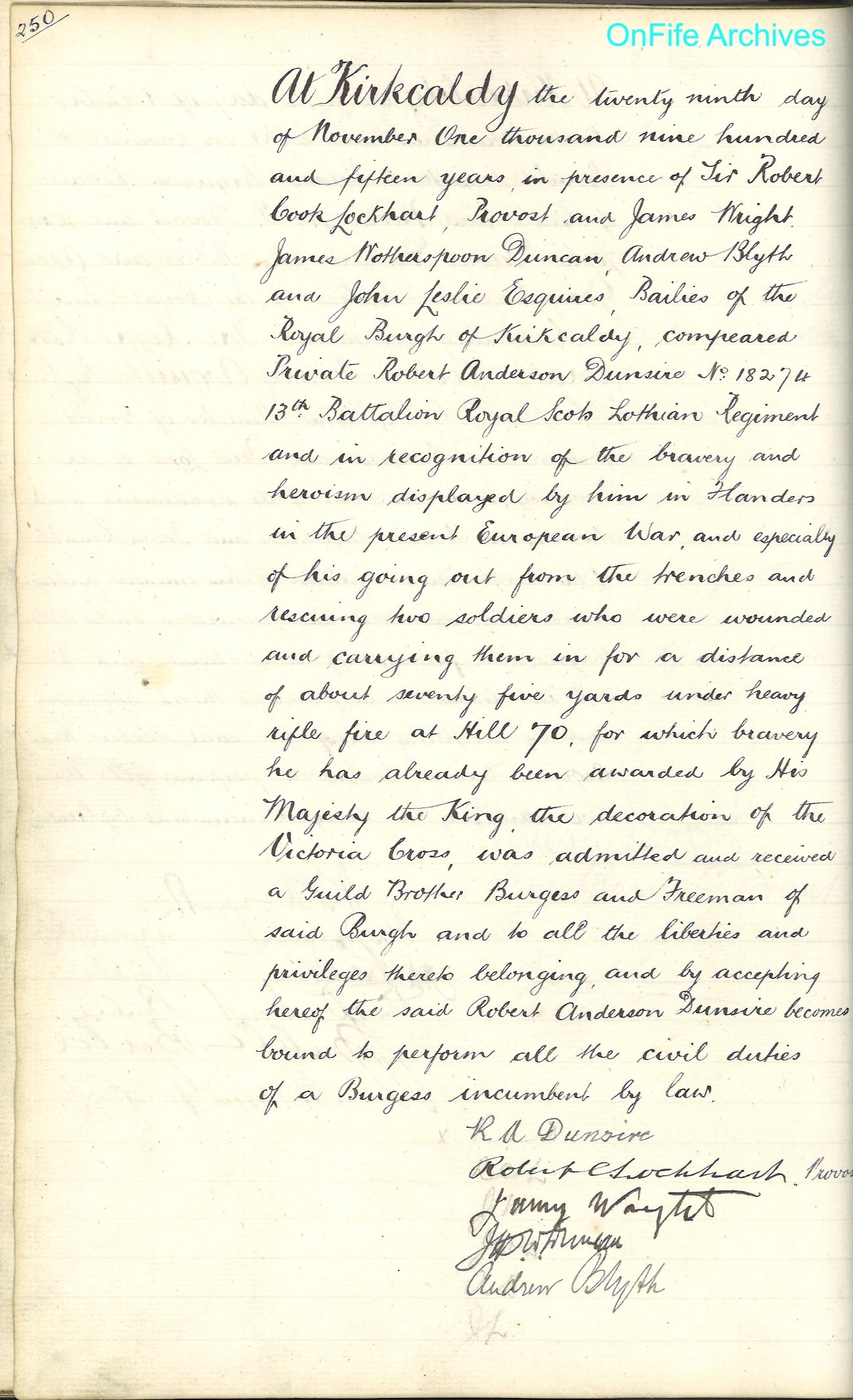
An image of the original Burgess Ticket follows:
Robert’s reply was delivered with his usual smile and humility.
Among his comments was the following: ‘Accept my sincere and grateful thanks
for making me a Burgess of the Burgh of Kirkcaldy and placing my name among
those who were honoured before me – men of culture, learning, scholarship and
skilled in languages and science.’ He pledged to do everything in his actions
and power to uphold the dignity and honour of Kirkcaldy that this position
expected of him.
Councillor Peter Herd of Whytebank, Kirkcaldy, toasted
Robert’s wife and parents. Councillor Herd was the son of Coalmaster Walter
Herd who had been the lessee of Dunnikier Colliery. When that was transferred
into the hands of the Bowhill Coal Company then The Fife Coal Company Peter
Herd remained a director of each Company. Councillor Herd was able to explain
that he had known Robert’s father for many years and could testify to his ‘high
character and the esteem in which he was held’. He also stated that Mrs Dunsire
was a good wife and mother. Thomas Dunsire made a brief reply of thanks and his
wife, Elizabeth, then made a brief speech in which she claimed her son to be a
citizen of Kirkcaldy. His education, scholastic and musical, had taken place in
Kirkcaldy.
The original scroll presented to Robert Anderson Dunsire VC
is held in the Museum of The Royal Scots withing Edinburgh Castle. They have
provided this image for use on this website.
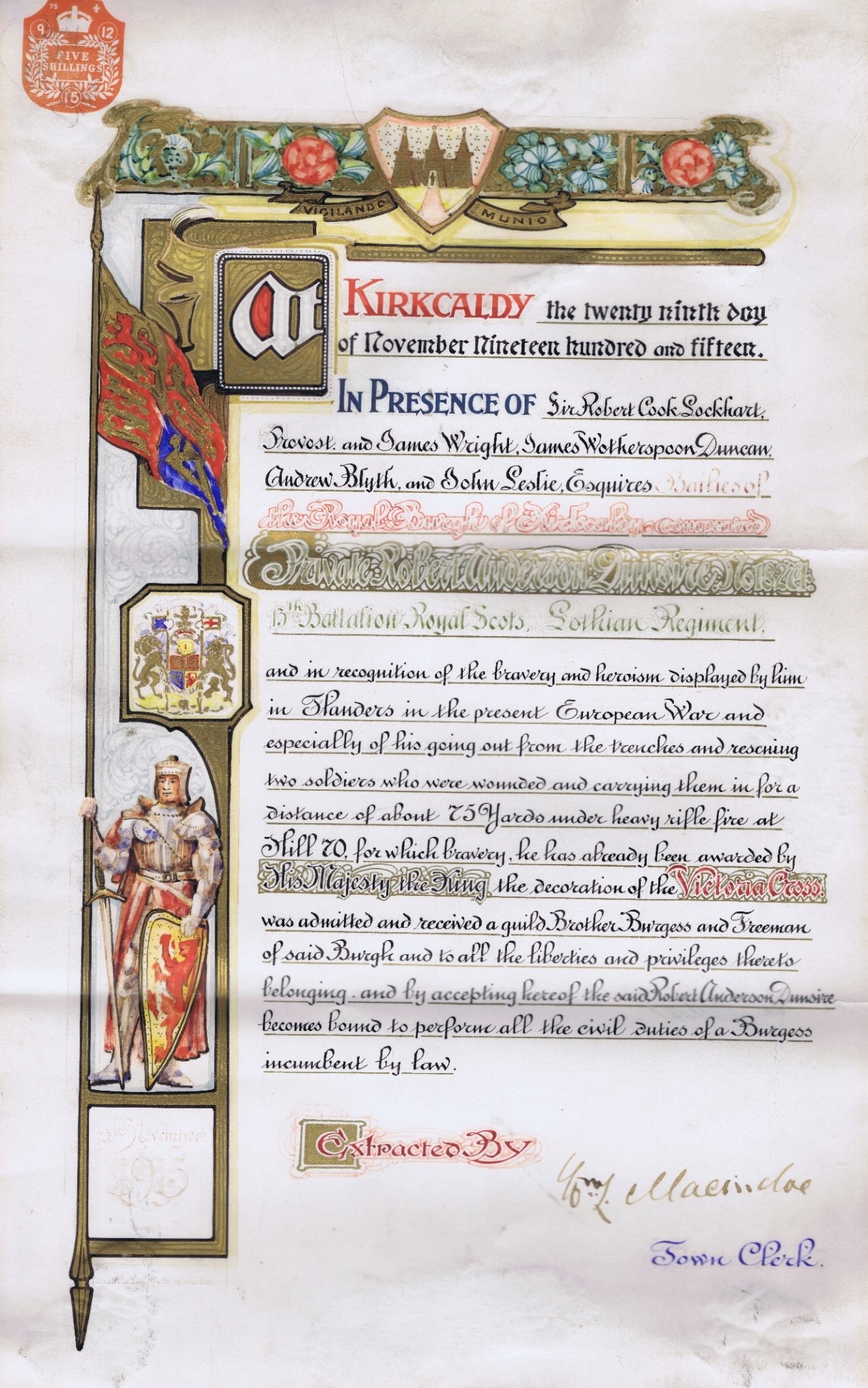
Attr: Original Parchment held by the Museum of The Royal
Scots
co-located with the Museum of the Royal Regiment of Scotland
at Edinburgh Castle
Buckhaven, Methil and Innerleven Presentation & Testimonial
When Robert and Kate met the assembled company for the
Presentation & Testimonial, organised by the Burgh of Buckhaven, Methil and
Innerleven, on the afternoon of Saturday, 4 December 1915 they must have had
very mixed emotions as they knew Robert’s return to France was imminent.
However, the send-off he was about to receive must have put a skip in his step.
The Fifeshire Advertiser summed it up meaningfully: ‘the
climax on Saturday when the town in which he was born, the town where he
resides and the parish, in which the family name is familiar for generations,
united in delighting to honour this worthy son’.
The musical entertainment that had been planned included the
Buckhaven Orchestral Society, under Mr Terris’s baton, who played an
entertaining selection. Buckhaven Town Band appeared on a second occasion to
join in the tribute to a fellow musician. Other artists added their
contribution, with Corporal Winter, Private Bartleman on Japanese violin,
Private Stone and Bandsman Hodge. Miss Keir was the accompanist for the day.
For a number of reasons several of the invited guests could
not make it to Denbeath that day. Many sent their best wishes in their absence
and Mr Carlow JP telephoned to add a further £5 (£500 today) to the
testimonial.
It is worthwhile considering a few of the quotes made by Provost Rose in his opening remarks, which are listed below:
Present a memento of the regard his fellow townsman and
others have for him.
Private Dunsire is endowed with a courage and bravery which
they could only admire and revere.
His actions deserve the highest recommendation.
If asked Private Dunsire would say that he only did his
duty.
The nerve of the man made the impossible possible.
It was not a fanatical disregard of life or danger – it was
the supreme control of the man over his actions, that control which enables a
man to raise himself above his fellow men and demonstrate a distinguishing
trait of his character.
It is given to a few to be the possessor of a Victoria
Cross, and it is an honour known the world over, it is an emblem which deserves
the highest respect.
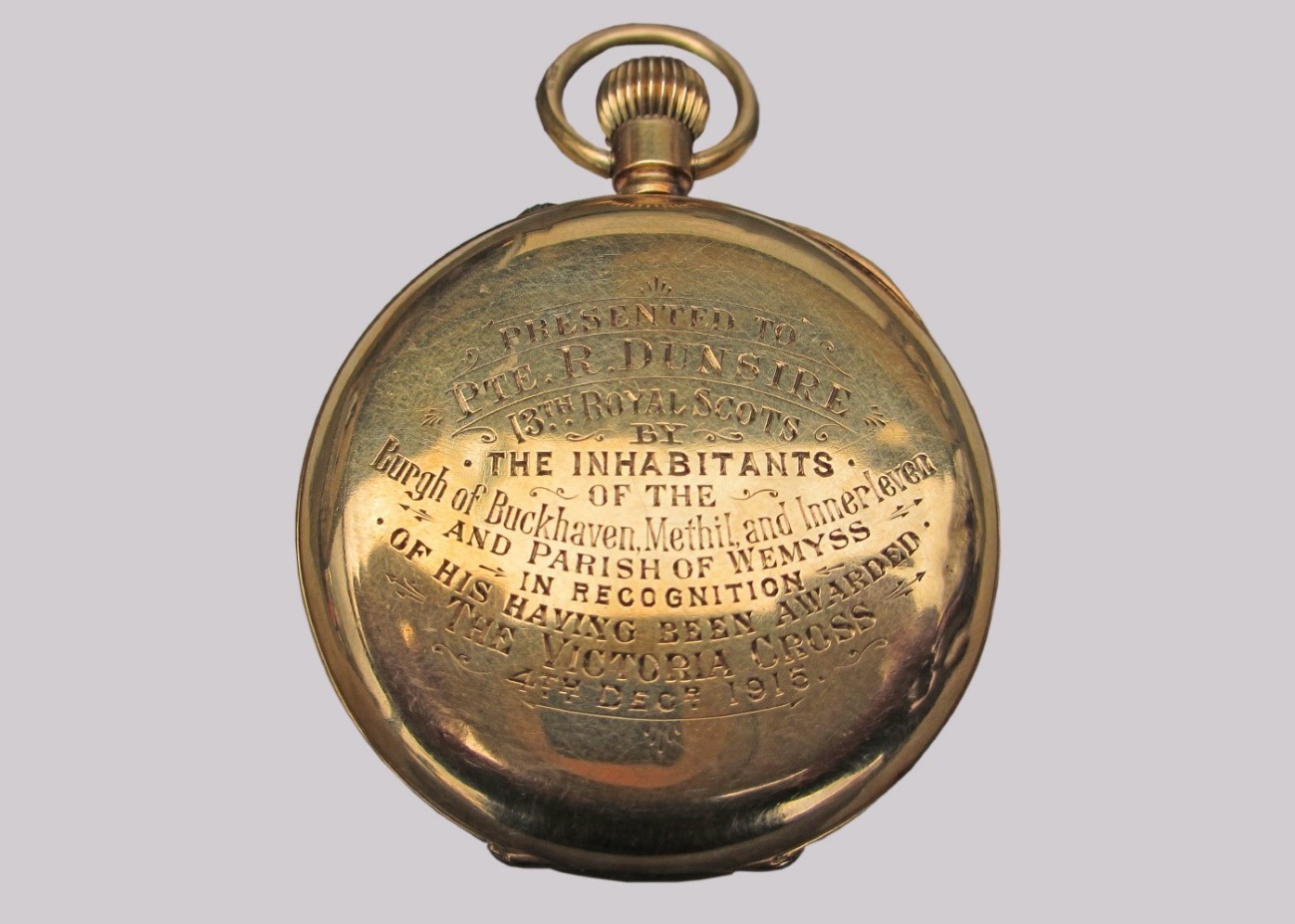
Provost Rose then presented Robert with an inscribed gold
watch and chain, ‘From the Inhabitants of the burgh of Buckhaven, Methil and
Innerleven and the Parish of Wemyss’. There was also £55 of war stocks. Kate
was presented with a beautiful gold brooch, set with pearls and amethyst, that
it was hoped she would wear on future occasions when out with Robert.
Attr: The Family of Robert Dunsire VC
Robert expressed his deep gratitude for the gifts that he
and Kate had received. When worn they would be much admired and would be looked
upon as a token of the great kindness and respect shown to humble citizens and
a soldier of our King and Country.
Robert then showed the humorous aspect of his character by
saying, ‘If you are going to carry your appreciation of my humble service to my
king and country much further, I fear the strain both upon my mind and body may
be too much for me, and that the reaction may have serious consequences for my
health’. He then expressed his deep appreciation of the unanimous feelings of
love and gratitude to him, a humble soldier, and hoped that this would
encourage more young men to volunteer. His speech carried a powerful message
for young people to join Allied Forces, who were doing their duty both to God
and man. His plea was for a victory all over Europe, when the true spirit of
the fatherhood of God and the brotherhood of man would be established. He ended
his speech by repeating his and Kate’s gratitude for the valuable gifts that
had been presented to them that day.
Dr Anderson proposed a vote of thanks to all who had made
and contributed to such a successful recognition send-off occasion for Robert.
Dr Anderson had considerable experience as a GP in Fife but, at the time of
this ceremony, was Medical Superintendent of Wemyss Memorial Hospital. He was
given £4 (£400 today) for hospital funds. Dr Anderson became a World War I
Surgeon Specialist at the 69th General Hospital, in Egypt and Palestine.
The testimonial closed with ‘Auld Lang Syne’ and ‘God Save
the King’. Robert would soon be home and packing his kit.